Chasing Absolute Zero
There is a floor under temperature. You can walk toward it your whole life and never step on it.
The number where the thermometer bottoms out
Heat is motion — atoms jiggling, molecules tumbling over one another. Cool something and that motion calms. Keep cooling and you'd expect to reach a point where it stops entirely. That point is absolute zero: 0 kelvin, or about −273.15 °C.
The number wasn't found by reaching it. In the early 1800s, experimenters noticed that a gas shrinks by a fixed fraction for every degree you cool it. Draw the line and extend it, and the volume hits zero at the same place every time — around −273 °C — no matter which gas you started with. In 1848 William Thomson, later Lord Kelvin, recognized that this wasn't a quirk of gases but a true bottom to temperature, and anchored a new scale there.
Why "all motion stops" is a white lie
The schoolbook picture says atoms freeze solid at absolute zero. Quantum mechanics disagrees. Even in its lowest possible state, a particle keeps a residual zero-point jiggle it can never surrender. So absolute zero isn't perfect stillness — it's the state of least possible energy, where you've extracted every scrap of heat the system will give up and its disorder bottoms out.
That last point is the rule that ruins the party.
The third law, and the ban on arriving
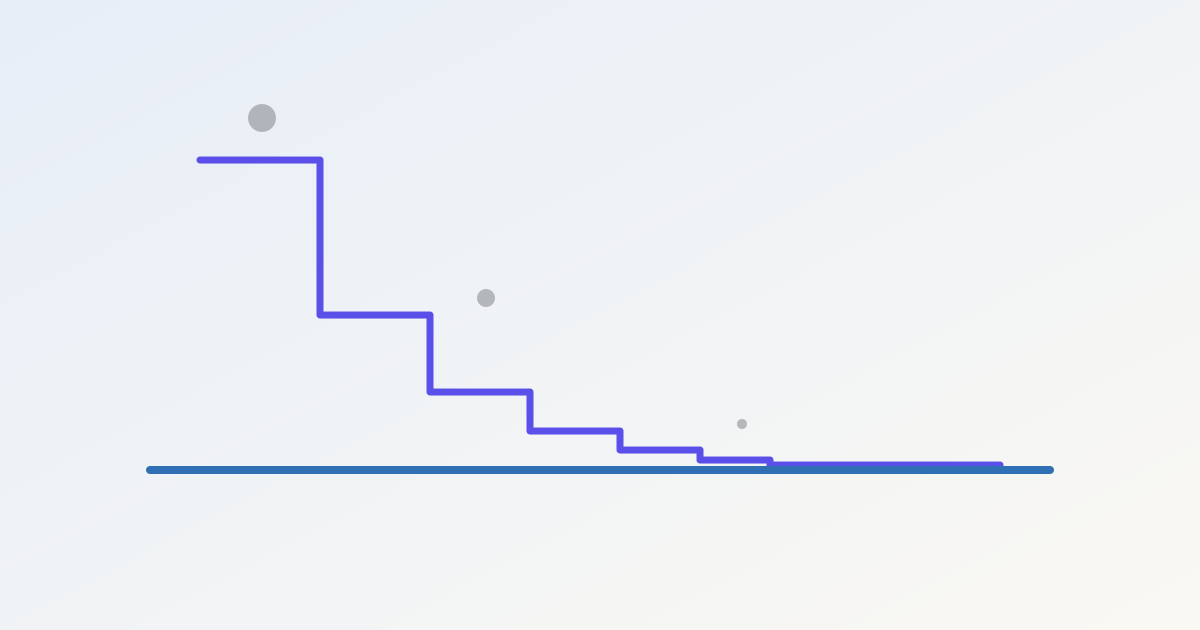
As a system nears absolute zero, each step that removes its remaining heat does less than the step before — so finishing would take infinitely many of them.
This is the third law of thermodynamics: you can approach absolute zero, but you cannot reach it in any finite number of steps. Every cooling method works by carrying off a slice of whatever heat is left. Near the bottom, each slice shrinks toward nothing. It's Zeno's racetrack rewritten in physics — always halving the gap, never closing it.
The long climb down
The race to the cold drove a century of ingenuity:
- 1877 — oxygen is liquefied, the first "permanent" gas to give in.
- 1898 — James Dewar liquefies hydrogen near 20 K, and invents the vacuum flask to hold it.
- 1908 — Kamerlingh Onnes liquefies helium at about 4 K in Leiden. Three years later, working in that same deep cold, he discovers resistance vanishing to zero.
- Today — laser and magnetic cooling reach billionths of a kelvin, colder than anywhere in nature. The coldest known natural spot, the Boomerang Nebula, sits near 1 K; our labs beat it by a factor of a billion.
We have reached temperatures within a hairsbreadth of zero — picokelvins, trillionths of a degree above the floor. Close enough to study exotic states of matter the universe is never cold enough to show us on its own. But the last sliver stays exactly where Kelvin drew it: visible, approachable, and forever out of reach.