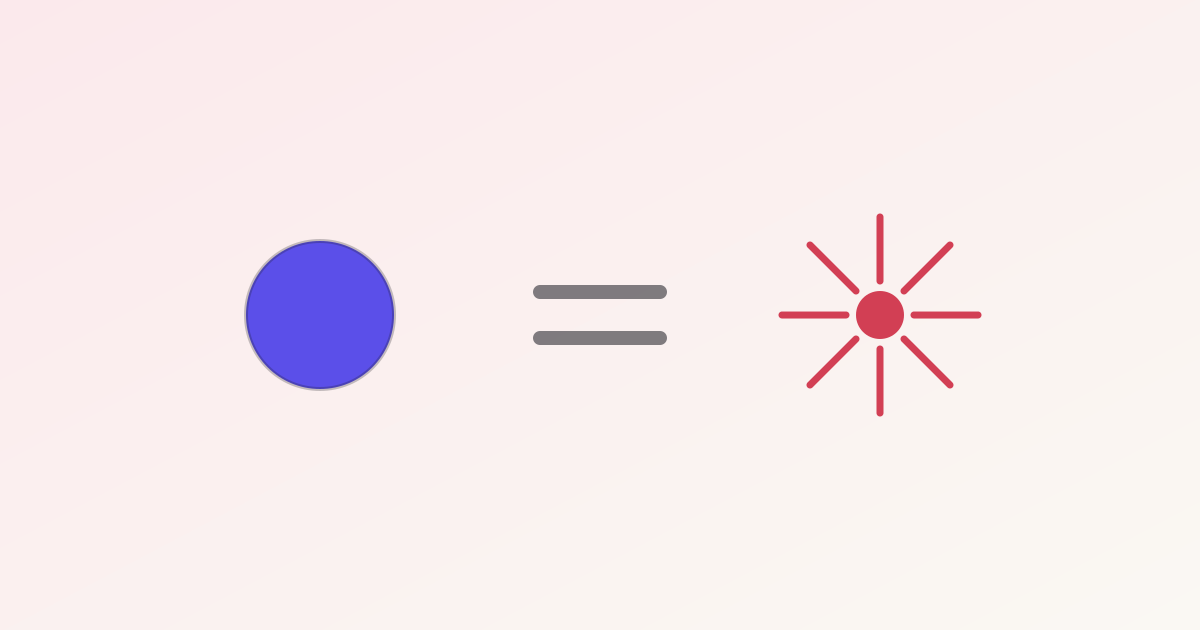
What E = mc² Actually Says
Probably the most famous equation in the world, and most of what people "know" about it is wrong. It isn't really about bombs. It isn't about going fast. Let me take the misreadings apart one at a time, because the real meaning is simpler and stranger than the myths.
Misreading 1: "It's the bomb equation"
E = mc² describes a nuclear weapon, yes — but it equally describes a flashlight battery, a cooling cup of coffee, and you. The equation is a universal statement about all mass and all energy, not a special fact about uranium. A charged battery is a hair heavier than a dead one. Hot coffee weighs a touch more than the same coffee gone cold. The differences are absurdly tiny, which is exactly why nobody noticed for centuries. A bomb is just the rare case where the effect grows large enough to see — and to fear.
Misreading 2: "It's about the speed of light"
The c in the formula is the speed of light, so people assume the equation is about moving fast. It isn't. Nothing in E = mc² is going anywhere. The c² is a conversion factor — an exchange rate between two currencies that turn out to be the same money measured in different units.
Mass and energy aren't two things that swap into each other so much as two names for one thing. Mass is simply energy sitting still — frozen, concentrated, bottled up.
Why does the speed of light set the exchange rate? Because that number falls out of relativity's single stubborn rule about light, and once you follow the logic, c² is the factor that has to appear.
Why the energy is so enormous
c² is a staggering number: the speed of light squared, about 9 × 10¹⁶ in metric units. That's the exchange rate, and it is brutally lopsided in energy's favor. Convert a single gram of anything completely and you'd release roughly 90 trillion joules — comparable to a small nuclear blast, or enough to run a household for thousands of years.
So the headline isn't "mass can become energy." It's "the exchange rate is gigantic." A speck of mass is worth an avalanche of energy, which is why the Sun can pour out light for billions of years while shedding only a modest fraction of its bulk — it shines by turning mass into light, about four million tonnes of itself every second.
The cleanest demonstration
If you want E = mc² in its purest form, you want matter's mirror twin. When a particle meets its antiparticle, the two don't merely react — they vanish, the whole of their mass reappearing as energy. No leftover ash, no fragments. That's the equation running at full efficiency, with no fuel left behind.
And it runs both ways. In particle accelerators we do the reverse: pour in enough energy and brand-new particles condense out of it, mass crystallizing from pure motion. Energy freezes into matter; matter melts into energy. The exchange rate, c², never changes.
The one-line version
E = mc² doesn't say things can go fast or blow up. It says mass is frozen energy, and the exchange rate is enormous. Everything else — reactors, stars, annihilation — is just that one sentence, collecting its bill.