Why Do We Age? — Open Notebook
Open notebook. Aging feels obvious until you ask why it happens at all — then it splinters into several competing stories. Here's where I've got to.
The question
Why should a living thing, which spends its whole existence repairing and rebuilding itself, slowly get worse at it? A salamander regrows a lost limb. Some trees and a few jellyfish barely seem to age. So aging isn't a hard law of biology — it's something that needs explaining.
The leading theories
- Programmed aging. Maybe aging is built in: a genetic schedule, like puberty at the far end of life. The snag is that evolution rarely selects for decline. A subtler version, antagonistic pleiotropy, says genes that help you early — fast growth, early reproduction — quietly cost you later, and evolution takes the early payoff every time.
- Accumulated damage. Aging as wear and tear: DNA collects mutations, proteins misfold and clump, mitochondria falter. Free radicals — reactive scraps left over from burning oxygen — nick molecules faster than repair can keep up. The damage compounds.
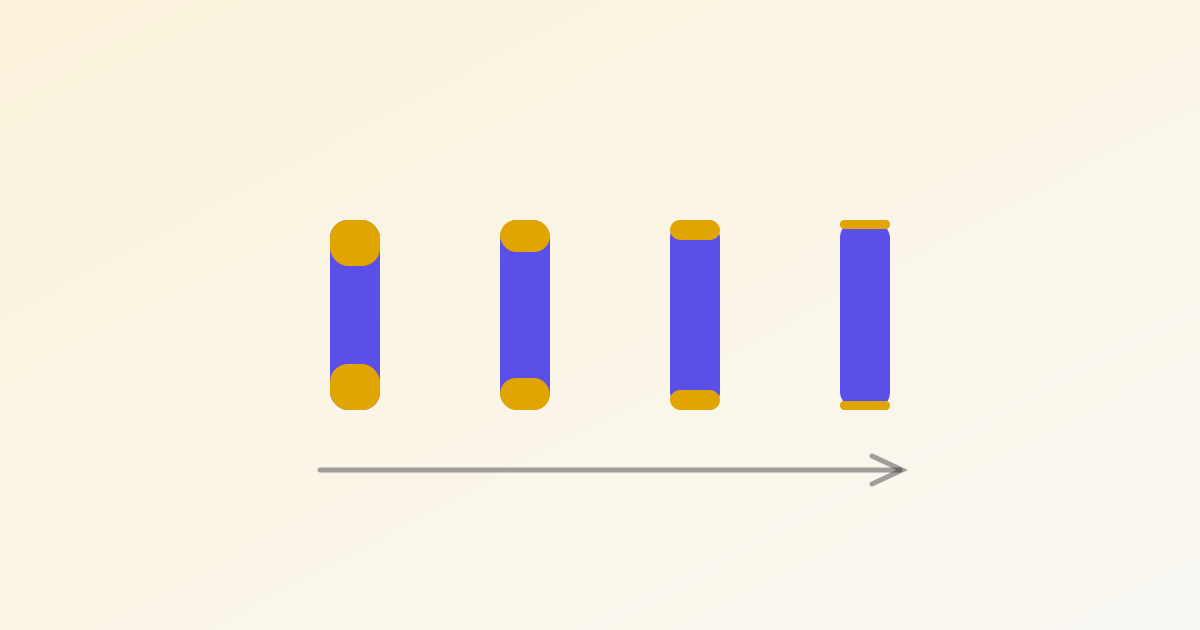
- Telomere attrition. The caps on our chromosomes shorten a little with every cell division. Run them down and cells stop dividing (the Hayflick limit) and turn senescent. Real — but not the whole story, since plenty of aging happens in cells that rarely divide at all.
- The entropy framing. Stand back and aging looks like the slow tax that thermodynamics charges any self-maintaining machine. A body holds itself in order by spending energy, but every repair is slightly imperfect, and disorder seeps in — the same one-way drift behind why broken things don't unbreak.
These aren't really rivals; they're layers. The modern "hallmarks of aging" framing just lists many of these damage processes side by side and treats aging as their sum.
Where I currently lean
Mostly toward damage plus evolutionary neglect. Selection's grip loosens once you've reproduced, so it never bothered to perfect lifelong repair — and on top of that indifference, damage piles up while entropy sets the backdrop. I don't think there's a single ticking "death clock" gene. Aging looks like many small failures converging, which is also why no one pill has reversed it.
It rhymes with another maintenance puzzle: a big part of what sleep seems to be for is nightly cleanup and repair — and what wears out in aging is precisely that repair capacity.
What would change my mind
- A single, clean intervention that broadly resets aging (cellular reprogramming is the live candidate) would push me toward "more programmed than I thought."
- A fully decoded "negligibly senescent" animal — one that genuinely doesn't age — might reveal a master switch I'm currently betting doesn't exist.
Changelog
- 2026-02-09 — Started this note leaning hard on free-radical damage. But antioxidant supplements don't reliably extend lifespan, so I've downgraded it from headline cause to symptom.
- 2026-04-18 — Added the entropy framing after re-reading the thermodynamics. It's a backdrop, not a mechanism — noting that so I don't over-explain everything with it.
- 2026-06-09 — Senescent-cell clearance results nudged me a bit further toward the damage-accumulation camp.