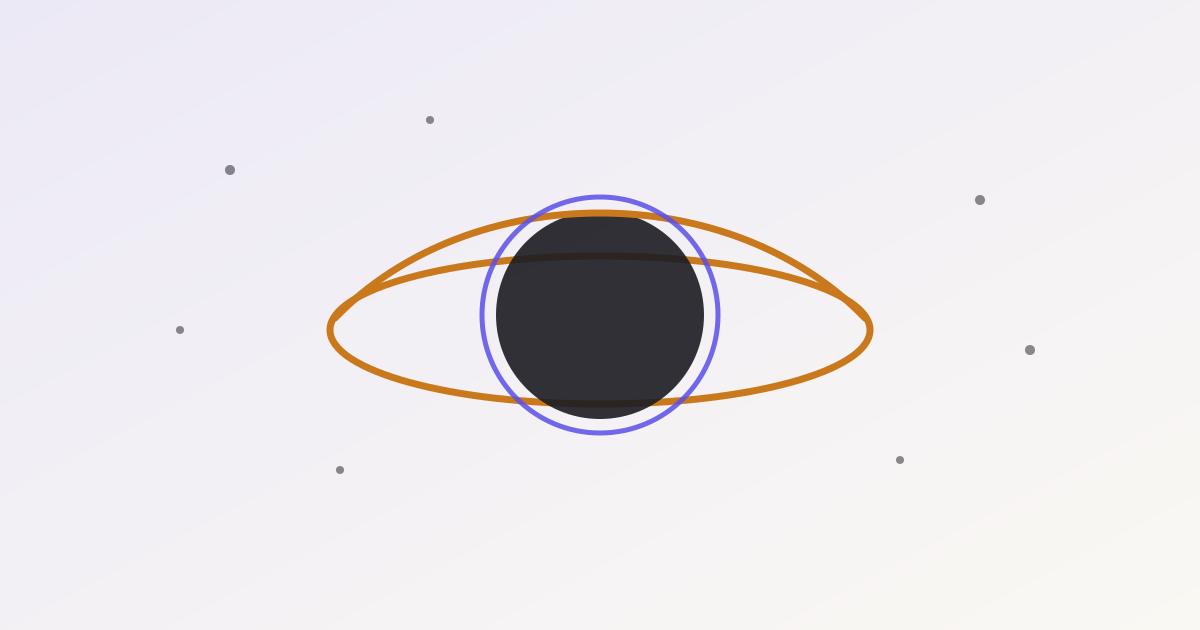
What's Actually Inside a Black Hole
A black hole is one of the most misunderstood objects in the universe — starting with the word "hole."
What it isn't
Three corrections first:
- Not a hole. Nothing has been scooped out. A black hole is matter — a great deal of it — crushed into a tiny region. It's the most concentrated stuff there is.
- Not a cosmic vacuum cleaner. It doesn't suck. Swap the Sun for a black hole of the same mass and Earth would keep orbiting exactly as before, just colder. Gravity from a distance only cares about how much mass there is, not how small it's packed.
- Not a tunnel to elsewhere. That's a wormhole — a separate, entirely hypothetical idea. A black hole is a destination, not a doorway.
So what is it?
Where the future points inward
A black hole is what happens when gravity-as-geometry is pushed to its limit: spacetime curved so steeply that the curve folds over on itself.
Out here, you can move any direction through space but only forward through time. Cross a black hole's event horizon and the geometry tips so far that "toward the center" becomes a direction in time rather than space. Falling inward stops being a choice you could resist with a powerful enough rocket. It becomes as unavoidable as next Tuesday. Every path your future can take leads down.
That's the honest meaning of the point of no return. The horizon isn't a wall or a membrane — if the black hole is large, you'd drift across it without feeling a thing. It's simply the last place from which a beam of light could still, barely, climb back out. Past it, even light's future points inward.
The part we genuinely don't know
Keep falling, and general relativity makes a strange prediction: everything piles toward a central point of zero size and infinite density — a singularity.
But infinity is never an answer in physics. It's a flare the theory sends up to say I've stopped working here. At the center, gravity is intense on a scale so small that quantum mechanics must also apply — and we have no theory that handles both at once. So the truthful reply to "what's at the middle of a black hole?" is this:
We don't know. The singularity isn't something we've found. It's a placeholder for physics we haven't written yet.
None of which means we're guessing blindly. We've tracked stars whipping around the invisible giant at our galaxy's center, photographed the shadow a horizon casts on glowing gas, and felt the ripples two black holes send out when they collide. We've even worked out, on paper, that the horizon isn't perfectly black — that it glows faintly and will one day evaporate. A shade less mass in the collapsing core and it would have halted at a neutron star instead — one notch short of a horizon. The outside of a black hole is now ordinary astronomy. It's the inside that remains a frontier.