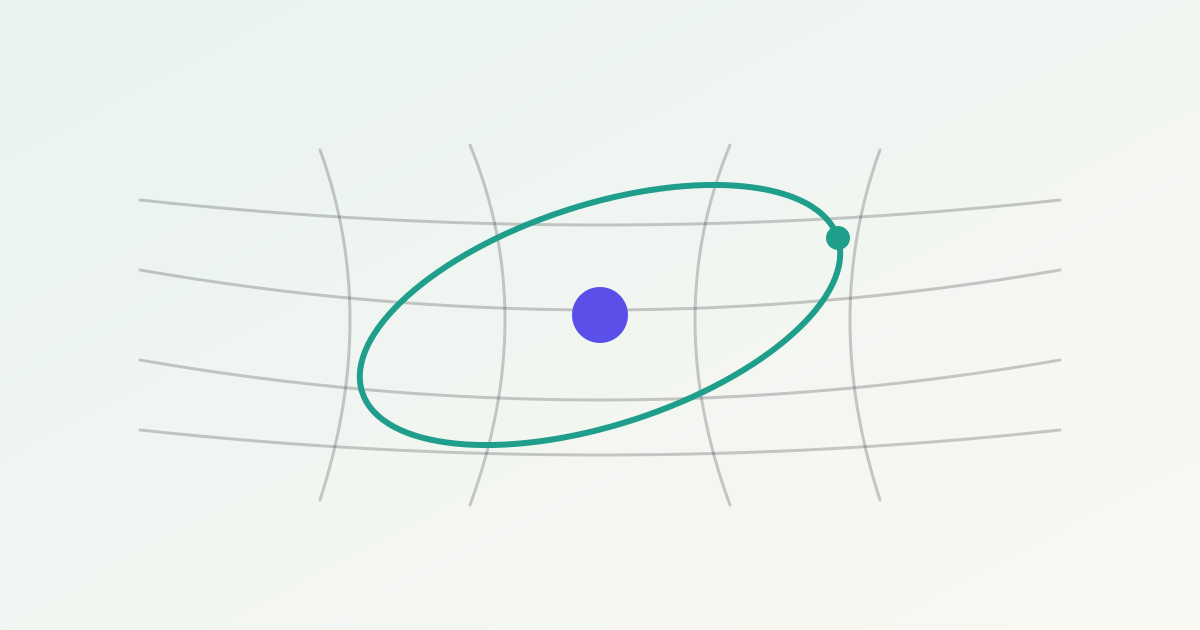
Why Gravity Is Geometry, Not a Force
You have seen the picture. Let me ruin it, then give you a better one.
The trampoline everyone shows you
Here is the standard demo. Stretch a rubber sheet, drop a bowling ball in the middle, and it sags into a dip. Roll a marble nearby and it curves around the dip, maybe spirals in. There, says the presenter — that is gravity. Mass bends space, and things roll into the bends.
It is a lovely picture. It is also quietly cheating.
Why the trampoline is wrong
Ask the obvious question: why does the marble roll down into the dip? Because real gravity — the Earth's, under the table — is pulling it down the slope of the sheet. The demo explains gravity by secretly assuming gravity. It is a circle.
It cheats a second way. A marble sitting still on the sheet, off to one side, just sits there. But hold a real apple still in the air beside a planet and let go, and it falls. The trampoline has no answer for that, because it left out the most important ingredient.
That ingredient is time.
The real idea: straight lines in a bent world
Einstein's picture is not space bending — it is spacetime bending, space and time woven together (a fabric we already had to stitch the moment light's constant speed bent both of them). And the rule for moving through it is almost insultingly simple:
Everything coasts along the straightest path available — a "geodesic" — through spacetime. Mass and energy curve spacetime; that curvature just changes which paths count as straight.
No force. No pull. A planet orbiting the Sun is going straight; it only looks like a loop because the spacetime it crosses is curved — the way a plane flying "straight" over the globe traces a curve on a flat map.
Here is the part that fixes the still-apple problem. You are never truly sitting still: you are always moving through time, second after second, even parked in a chair. Mass tilts those time-directions slightly toward itself. So your perfectly straight path through time gets bent, a little, into a path through space as well — and that bending toward the ground is what you feel as weight. Everyday gravity is mostly the curvature of time, not space, which is exactly what the trampoline omits.
And the kicker: free fall is the natural, force-free state. An astronaut in orbit feels nothing because she is going straight. The thing that actually shoves you around is the floor, pushing up, holding you off your natural path.
Where the geometry goes next
Once gravity is geometry, strange things become possible. Curve spacetime hard enough and you get a region you can fall into but never out of. Jostle it and the curvature itself ripples outward as waves you can listen for. And because orbits read the curvature directly, you can weigh a planet just by timing its moons — no scale required. And it reaches all the way down into the mundane: because a clock ticks slower the deeper it sits in the curvature, the satellites that drop the blue dot on your map run measurably fast, and have to be built to compensate.
The trampoline was never the answer. It was a finger pointing at one.