How Do You Weigh a Planet?
A short FAQ. You cannot put a planet on a bathroom scale — and you don't have to. Gravity does the weighing; you just read the result off a moon.
Wait — "weigh" a planet?
Loosely, yes, though what we really want is its mass (how much stuff it's made of), not its weight (how hard some particular gravity pulls on it). Weight depends on where you stand; mass doesn't. When astronomers say they've weighed Jupiter, they mean they've measured its mass. A scale is the wrong tool anyway — it needs the planet's gravity to press down on it, which is the very thing we are trying to find.
So how do you actually do it?
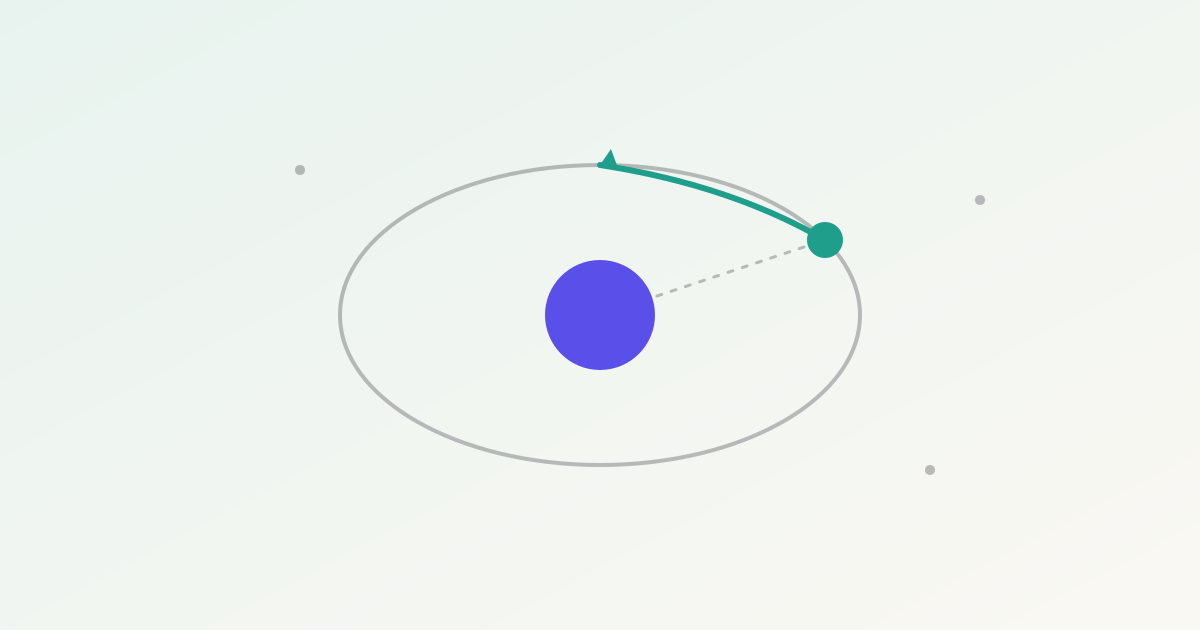
Watch something orbit the planet, and time it. A moon circling a planet is in a constant tug-of-war: its urge to fly off in a straight line, balanced against the planet's gravity pulling it inward — the very falling-and-missing that keeps any moon from dropping. How fast it must travel to hold that balance depends on exactly one thing about the planet — its mass.
Newton, sharpening Kepler's laws, turned this into a recipe:
- Measure how long the moon takes to complete one orbit (its period).
- Measure the size of that orbit (the moon's distance from the planet).
- The mass falls out: roughly, mass ∝ (distance)³ ÷ (period)².
A small moon's own mass barely matters here, so we ignore it. Feed in the period and distance, and the planet's mass pops out the other end. The same trick, aimed at the Sun with Earth playing the "moon," weighs the Sun.
What about a planet with no moons?
Mercury and Venus have none — so we send our own. A passing spacecraft is a tiny moon for a few hours: track how its path bends and how its radio signal shifts as the planet's gravity tugs it, and you get the mass the same way. Before spacecraft, astronomers read off the subtler gravitational nudges a planet gives its neighbors.
How do we turn an orbit into kilograms?
The recipe needs one universal conversion factor: G, the strength of gravity itself. Henry Cavendish pinned it down in 1798 by measuring the faint attraction between lead balls in his lab — a measurement so delicate the feat got nicknamed "weighing the Earth." With G in hand, an orbit's geometry becomes an actual mass in kilograms.
Is this really how we know Jupiter's mass?
Yes — and to many digits. Galileo's four big moons have been timed for centuries; their orbits give Jupiter's mass with exquisite precision. Earth's mass comes from the Moon (and now countless satellites); the Sun's, from the planets. The Moon pulls double duty: the very tug we time to weigh the Earth is also, spread a little unevenly across the planet, what raises the tide twice a day.
There is a deeper truth under the arithmetic. Newton's formula works flawlessly here, but Einstein showed that gravity is really the geometry of spacetime — the planet curves the space around it, and the moon merely coasts along that curve. Either way, the moon's faithful orbit is the planet quietly announcing its mass, century after century, to anyone who bothers to time it.