Why the Sea Rises Twice a Day, Not Once
Most coasts get two high tides a day, roughly twelve hours apart. If the Moon simply pulled the water toward itself, there would be only one.
The one-bulge story, and why it fails
Here's the picture most people carry: the Moon's gravity tugs the ocean upward on the side of Earth facing it, raising a bulge of water, and as the Earth turns, your coastline sweeps through that bulge once a day at high tide.
It's tidy, and it predicts one high tide daily. Reality delivers two. There is a bulge on the near side and a matching one on the far side — the face pointed straight away from the Moon, where the naive story says the water should be least disturbed of all. A pull toward the Moon cannot, by itself, pile water up on the opposite side of the planet. So the pull, on its own, cannot be the explanation.
It's the difference that matters
The fix is to notice that gravity weakens with distance, and the Earth is wide enough for that to count. The Moon's gravity — the same steady pull that keeps it falling around us — reaches the whole Earth, not only the sea. The Moon pulls on the near-side ocean, on the solid body of the Earth, and on the far-side ocean — but by different amounts. The near water, closest, is pulled hardest. The planet's centre, further off, is pulled a little less. The far water, furthest of all, is pulled least.
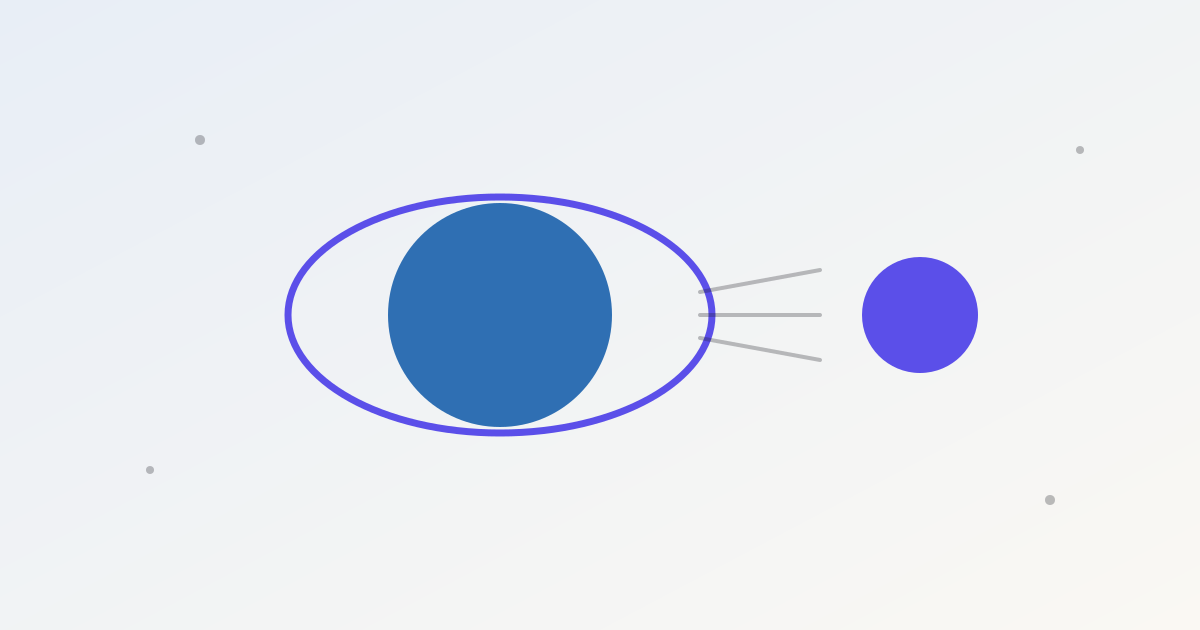
Now watch it from the Earth's own point of view. Relative to the planet as a whole, the near water is drawn ahead, toward the Moon — while the far water gets left behind, because the rest of the Earth is pulled out from under it more strongly than it is. Stretched from both ends at once, the ocean stands up in two bulges on opposite sides. The Earth rotates through both, so each coast meets a high tide roughly every twelve hours.
Tides aren't caused by the Moon's pull. They're caused by the difference in that pull across the width of the Earth — a stretching, not a lifting. That's why there are two.
The Sun does the same thing with less than half the Moon's tidal reach — despite its overwhelmingly larger mass — because it sits so far away that its pull barely differs from one side of the Earth to the other. When Sun and Moon line up — the same alignment that now and then yields an eclipse — their stretches add into big "spring" tides; when they sit at right angles, they partly cancel.
The truest fingerprint of gravity
This stretching-by-difference has a grander name — a tidal force — and it is the real signature of gravity as the curving of spacetime. It is what you would feel falling toward a black hole: pulled harder at the feet than the head, until you're drawn out into a thread. The ocean's daily two-step is the very same effect, mercifully gentle.
The honest caveat: real tides are far messier than two clean bulges. Continents block the water, ocean basins slosh at their own rhythms, and a handful of places get only one tide a day, or almost none. The two-bulge model is the cause; the world's ragged coastlines write the rest.
Next time the tide rolls in, know that the Moon isn't lifting the sea. It's stretching the whole Earth — and the water is merely the part that shows.