Your Phone Trusts Einstein With Your Location
Every time your phone drops a blue dot on a map, it is quietly assuming that time runs at different speeds in different places. It is right.
How the dot actually finds you
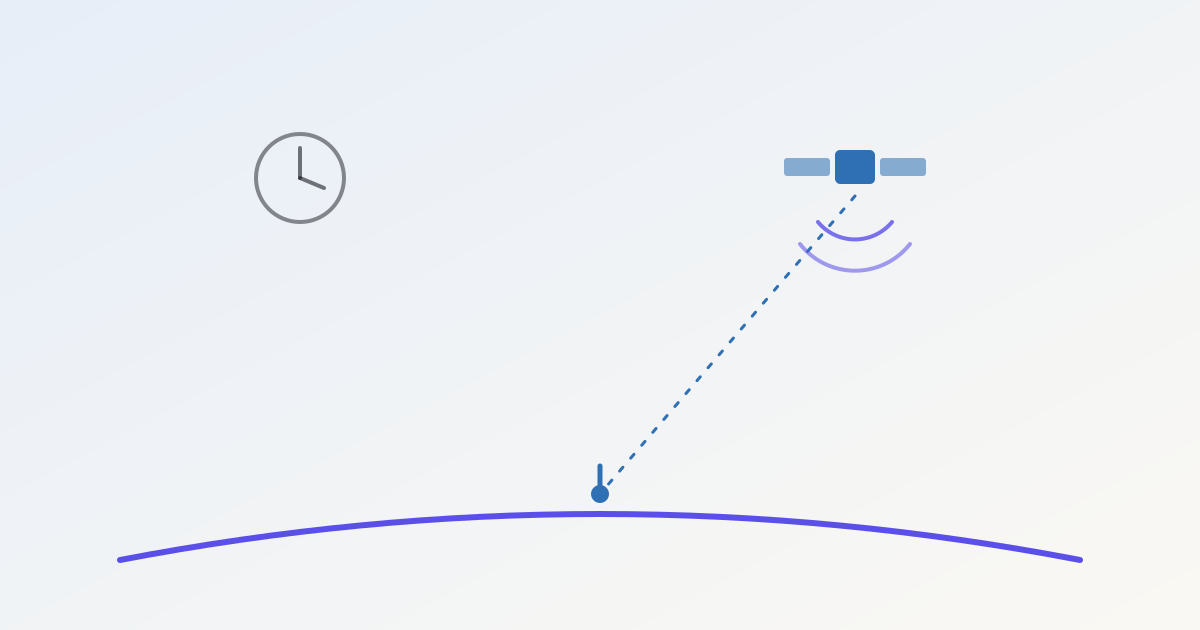
A GPS receiver never sends anything. It listens. Overhead, a couple of dozen satellites each broadcast, over and over, one message: this is the time, right now, by my onboard atomic clock. Your phone catches signals from several at once, notes how long each took to arrive — a few hundredths of a second — and multiplies by the speed of light to turn each delay into a distance. A handful of distances pin you to one point on Earth.
The whole trick rides on timing. Light travels about 300 metres every microsecond — a millionth of a second. So if a satellite's clock and your phone disagree by even a single microsecond, your position is off by the length of three football fields. The clocks must agree to billionths of a second. And that is where relativity walks in and refuses to be ignored.
Two effects, pulling opposite ways
The satellites orbit some 20,000 kilometres up, racing around the planet at roughly 14,000 km/h. Einstein's two theories make two firm predictions about their clocks.
- Motion slows time. A moving clock ticks slow. Because the satellites are moving so fast relative to the ground, their clocks fall behind ours by about 7 microseconds a day.
- Height speeds it up. Gravity is the bending of spacetime, and a clock deeper in a gravity well runs slow. The satellites sit high up, where Earth's pull is weaker, so their clocks run fast — by about 45 microseconds a day.
The gravitational effect wins. Net, an orbiting clock gains roughly 38 microseconds every day over one on the ground.
Thirty-eight millionths of a second
It sounds like nothing. Do the arithmetic and it is a catastrophe. Thirty-eight microseconds of clock error, times 300 metres per microsecond, is more than ten kilometres of position error — per day. Left uncorrected, GPS would place you in the wrong neighbourhood by breakfast and the wrong city by nightfall.
So the fix is built in from the start. The atomic clocks on GPS satellites are deliberately tuned, before launch, to tick at the "wrong" rate — slightly slow — so that once they are in orbit and relativity speeds them up, they come out reading exactly right.
The engineers who built the first navigation satellites were not all convinced this correction was necessary. So they added a switch to turn it off. They flipped it off, and watched the clocks drift, precisely as Einstein had said they would. They flipped it back on.
Relativity has a reputation as the physics of black holes and starships, something you will never actually meet. But it is running in your pocket, correcting itself thirty-eight millionths of a second at a time, every single time you ask a map where you are. The strangest theory in physics is also, by now, the most routinely trusted one going. Space and time and mass and energy — you bet your commute on all of it, and it pays out.