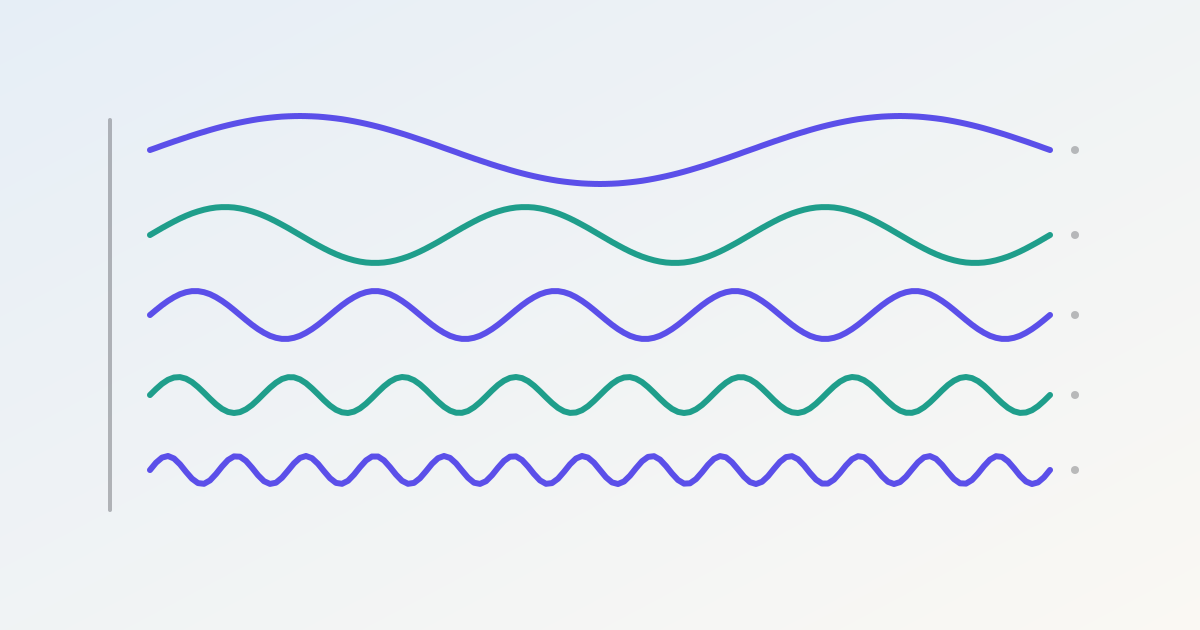
A Field Guide to Brain Waves
Press electrodes to a scalp and you can listen in on the brain — not to any single thought, but to a rhythm: a slow rising and falling hum that speeds up and slows down with whatever the mind is doing.
What an EEG actually hears
In 1924 a German psychiatrist named Hans Berger recorded the first electrical trace from a human scalp and found, to his own disbelief, a steady beat rising and falling about ten times a second. He sat on the result for five years, certain he would be laughed at, before publishing in 1929. He had invented the electroencephalogram — the EEG — and stumbled onto what we now call the alpha rhythm.
Be clear about what those wiggles are. An EEG does not hear individual neurons firing; a single spike is far too faint to reach the scalp. What it picks up — a few millionths of a volt, through the skull — is the summed electrical hum of millions of cortical neurons rising and falling roughly in step. A brain wave is not a signal travelling from A to B; it is a crowd, briefly synchronised. How fast the crowd pulses tracks, loosely but reliably, the state the brain is in.
The five rhythms
By long convention the hum is carved into five bands, slow to fast:
| Band | Frequency | When it takes over |
|---|---|---|
| Delta | 0.5–4 Hz | Deep, dreamless sleep; the slowest, largest waves |
| Theta | 4–8 Hz | Drowsiness, deep focus, memory and navigation |
| Alpha | 8–12 Hz | Relaxed wakefulness, eyes closed — Berger's rhythm |
| Beta | 13–30 Hz | Alert, engaged, actively working a problem |
| Gamma | 30–100 Hz | Concentrated attention and vivid perception |
A couple of things are worth noticing there. The rhythms run backwards from what you might guess: the brain is at its electrical calmest — the big, slow delta rollers — when it is most deeply asleep, and at its fastest, most fragmented buzz when wide awake and busy. And Berger's alpha has a lovely party trick: close your eyes and rest, and it swells over the back of the head; open them, and it all but vanishes, drowned out by the faster chatter of a brain with work to do.
What the rhythms are, and aren't, good for
The practical payoff is enormous. The stages of sleep are defined by their EEG signatures, delta marking the deepest. A seizure is a swathe of cortex catastrophically over-synchronising — thousands of neurons roaring in lockstep — and shows up unmistakably. Anaesthetists watch the EEG slow and flatten to judge how far under a patient has gone, and brain–computer interfaces read these rhythms to move a cursor or a robotic arm.
The fast gamma band is the most tantalising and the most argued-over: it climbs during focused perception, which has led some to wonder whether gamma synchrony is part of how the brain binds scattered features — colour, motion, edges — into one seamless scene. Maybe. It is a live research question, not a settled fact.
A single neuron's spike is a shout in the dark. What the EEG hears is the crowd — millions of cells falling briefly into step, then out again.
Which is also why you should be wary of anyone selling you control of your own "alpha waves" for calm and focus. The rhythms are real, and beautifully diagnostic. But they are the sound the orchestra makes, not the sheet music — and reading a hum is not the same as conducting it.