A Nerve Is Not a Wire
A thought, a flinch, the ache in a stubbed toe — all of it rides on the same one-millisecond pulse, repeated down a wet thread of a cell. It feels like electricity in a cable. It is nothing of the sort.
The wire you were promised
Ask most people how a nerve works and you get some version of a copper wire: a signal, electrical, shooting from fingertip to brain at nearly the speed of light. Half of that is right. A nerve impulse is electrical, and it is a signal. But it does not flow like current in a wire, and it is not fast. A signal in a copper cable travels at roughly two-thirds the speed of light — around 200,000 kilometres a second. The quickest nerve in your body manages about 120 metres a second: a million times slower, and slower even than a rifle bullet.
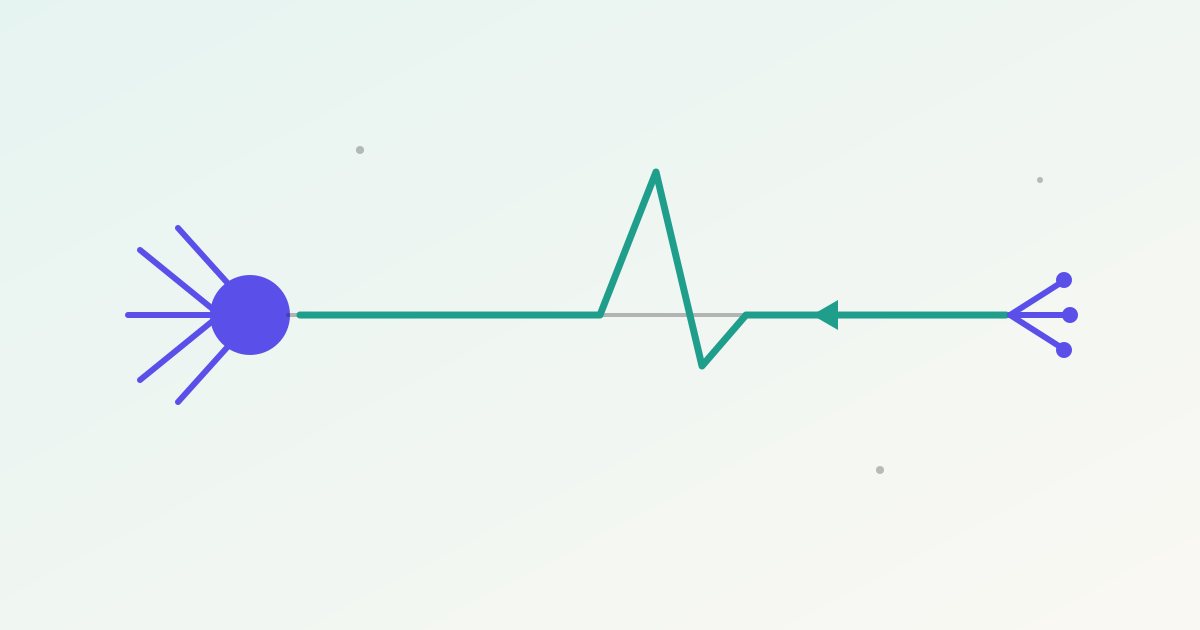
The reason for the sloth is also the reason nerves work at all. Nothing is racing down the fibre. What travels is a disturbance — a wave of rebuilding — and the cell has to remake the signal, chemically, at every step of the way.
A battery made of salt
Start with a neuron at rest. Its long output fibre, the axon, is a tube of salty water wrapped in a membrane, sitting in more salty water. But the salt is not the same on both sides. The cell spends enormous effort keeping sodium ions (Na⁺) mostly outside and potassium ions (K⁺) mostly inside, using a molecular machine — the sodium–potassium pump — that shoves three sodium out for every two potassium it hauls in, burning chemical fuel to do it. That pumping is one of the largest energy bills your body pays.
The result is a charged membrane. Tally the ions and the inside of a resting neuron sits about 70 thousandths of a volt (−70 mV) negative relative to the outside. It is, in effect, a tiny charged battery — a wall holding two mismatched crowds of ions apart, each straining to rush to the other side.
The spike
Now open a door. Studded through the membrane are voltage-gated channels — pores that snap open when the voltage across the membrane changes. Nudge one patch of membrane past a threshold, around −55 mV, and its sodium channels fling open. Sodium, held outside all this time, floods in. That inrush drives the inside briefly positive — up to about +40 mV — and that swing yanks open the sodium channels in the neighbouring patch, which flood, which yank open their neighbours. A collapse runs down the axon like a line of dominoes, each falling because the one before it fell.
That travelling collapse is the action potential — the spike. And it is all-or-nothing: below threshold, nothing; above it, the full spike every time, the same height whether the stimulus was a whisper or a slap. A neuron does not signal how much by shouting louder. It signals by how often it fires. Zoom out from one cell to millions firing in loose synchrony and those rates and rhythms are what an EEG reads off the scalp as brain waves.
Milliseconds later the sodium channels click shut and a second set, the potassium channels, open. Potassium streams out, the inside goes negative again, and the membrane resets — even overshooting into a brief numb spell, the refractory period, when it cannot fire. That enforced pause is what keeps the wave moving forward instead of sloshing backward: each patch, freshly fired, is briefly deaf while the one ahead lights up.
A nerve does not carry electricity the way a wire does. It carries a rumour of electricity — a disturbance in the salt, torn down and rebuilt cell by cell, the whole length of you.
The frog and the squid
That we know any of this is a two-century story with two animals in it. In the 1780s the Italian anatomist Luigi Galvani found that a dead frog's leg twitched when touched with metal, and argued for an "animal electricity" carried by the nerves — half right, and fiercely disputed by Alessandro Volta, who thought the charge came from the metals alone. (Volta was also half right; the quarrel gave us the battery.)
The mechanism stayed dark until an unlikely hero surfaced: the squid, which has a giant axon nearly a millimetre thick, fat enough to thread with a wire and measure. Using it, Alan Hodgkin and Andrew Huxley worked out — through the late 1940s, published in 1952 — the exact choreography of the opening and closing channels, sodium in then potassium out, timed to the millisecond. Their equations still describe the spike today, and won a Nobel Prize in 1963. The most electric thing in your body was decoded in a sea creature.
The gap, and the jump
Two tricks make the sluggish signal usable. The first is insulation: many axons are sheathed in myelin, a fatty wrapping laid down by helper cells and broken at regular gaps. The spike cannot form under the sheath, so it leaps from gap to gap, skipping the insulated stretches — saltatory conduction, from the Latin for "leaping." That is how a nerve climbs from a metre-per-second crawl up to its 120-metre sprint. Strip the myelin away, as diseases like multiple sclerosis do, and the leaping fails; the signal smears and stalls.
The second trick is the end of the line. Where one neuron meets the next there is no wire and no solder — there is a gap, the synapse, about twenty billionths of a metre wide. The electrical spike cannot cross it. So the arriving pulse triggers a squirt of chemical messengers that drift across the gap and land on the next cell, where they may — or may not — start a fresh spike. The signal turns from electrical to chemical and back again, hundreds of times, on its way through you.
That conversion is not a bug. It is the whole point. A wire only ever passes a signal along. A synapse can strengthen, weaken, or ignore it — and a gap that can change its mind is the beginning of learning and memory. Everything you have ever felt or decided was a line of these little collapses, running at the speed of a sprinter, not the speed of light.