The Slow Chemistry Inside a Battery
Crack open the idea of a battery and you find a chemical reaction that's been split in two and forced to pay a toll.
Two reactions that aren't allowed to touch
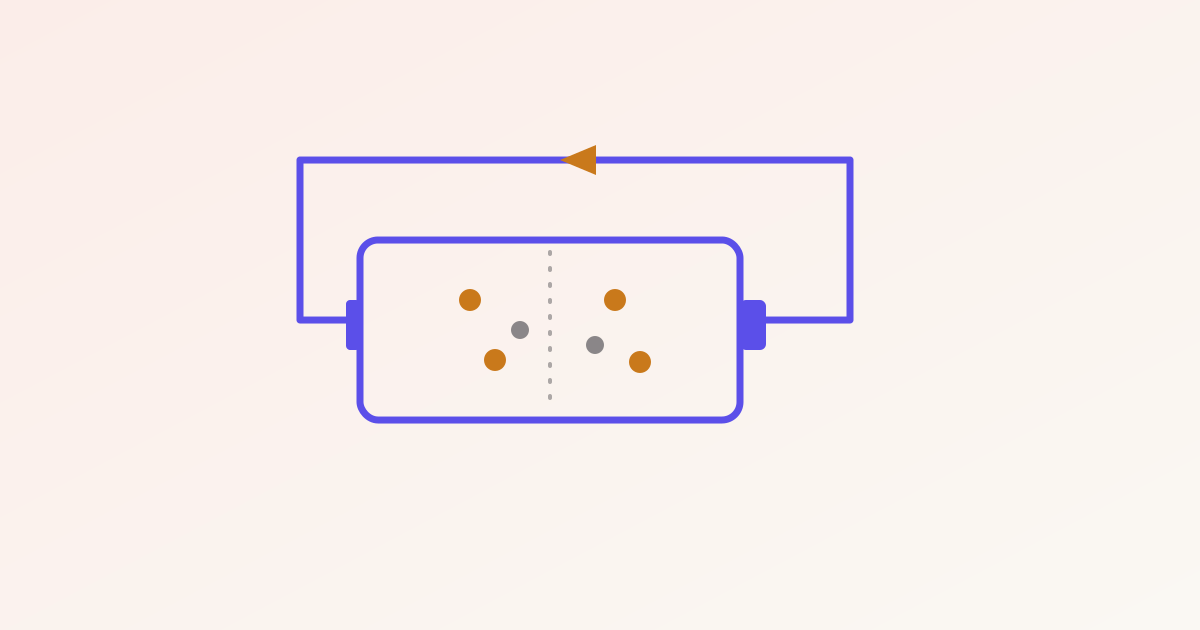
A battery runs on a reaction in which one substance gives up electrons and another takes them. Normally those two would meet directly and dump their energy as heat — think of a metal corroding. A battery cheats. It puts the electron-giver and the electron-taker in separate compartments, the anode and the cathode, joined inside only by an electrolyte that ferries charged ions but blocks electrons.
The electrons still want to make the jump. The only road open to them runs out one terminal, through your phone or flashlight, and back in the other. On that detour they do useful work.
A battery doesn't "store electricity." It stores chemicals primed to react, and makes their electrons take the long way around — through your device — to get where they were always going to go.
Discharge, then recharge
- Discharge. At the anode, atoms shed electrons (oxidation). Those electrons flow through the circuit to the cathode, where other atoms collect them (reduction). Meanwhile ions drift through the electrolyte to keep the charges balanced. Chemical energy becomes electrical energy.
- Recharge. In a rechargeable cell, you push electrons the other way with an external voltage, forcing the reactions to run backwards and rebuilding the original chemicals. A lithium-ion cell simply shuttles lithium ions between two electrodes — out during use, back during charging, like a rocking chair.
A single-use alkaline battery can't really do step two; its reaction won't reverse cleanly, so once the reactants are spent, it's finished.
None of this conjures energy from nothing. The charge in your power bank was paid for at the wall, and every joule is accounted for — chemical to electrical to light and heat — because energy only ever changes form. The same accountancy — energy stashed by keeping charges apart, spent when they are finally let go — is, near enough, how a nerve holds its charge, too.
Why every battery dies
Even the rechargeable kind wears out, because the reverse reaction is never quite perfect:
- Tiny side-reactions nibble away the active chemicals on every cycle.
- Crusty films build up on the electrodes, and the materials swell, crack, and crumble with repeated use.
- Stray metal whiskers (dendrites) can creep across the gap and short the cell out.
Each charge gives back a little less than the one before, so capacity quietly fades. A "dead" battery isn't empty of energy — it's stuck in a chemical arrangement it can no longer climb back out of.
That's the bargain inside every cell: useful, often rechargeable, and slowly degrading, one reaction at a time.