Energy Is Never Created. So Where Does It Go?
Richard Feynman liked to describe energy as a kind of cosmic bookkeeping. There's a number you can calculate about any system, and no matter what the system does — explode, freeze, fall, spin — when you add that number up again afterward, you get the exact same total. You never see "energy" itself. You only ever see the entries in the ledger: motion here, heat there, a stretched spring over in the corner. But the books always, always balance. Let me play accountant and follow a single payment all the way through.
Opening balance: the spring
Take a spring and stretch it. You've just deposited energy into it — elastic potential energy, sitting in the strained coils, waiting. Where did it come from? Your arm. And your arm's energy came from chemical bonds in breakfast, which a plant packed away from sunlight, which the Sun coined from mass. Every entry traces back to an earlier one. Nothing was created from nowhere.
Watch the money move
Let go. Now follow the energy from account to account:
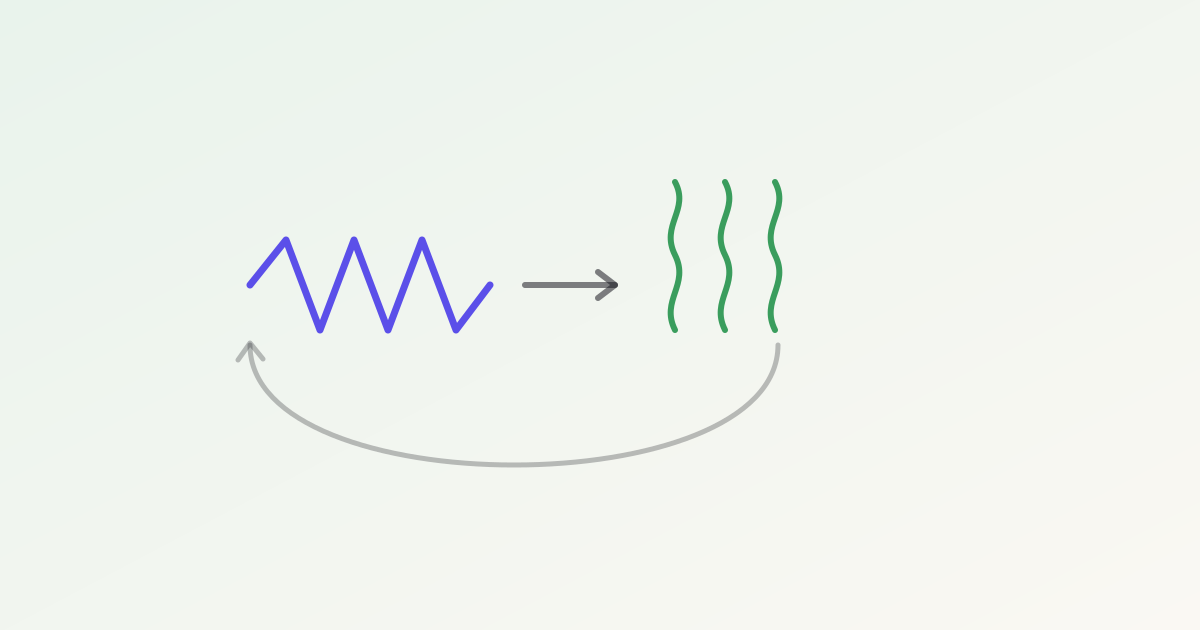
- Potential → kinetic. The spring snaps shut and flings a block across the table. The stored energy is now motion.
- Kinetic → heat. The block slides, friction grabs it, and it coasts to a stop. The motion didn't vanish — it became warmth. Block and tabletop are now a few atoms' worth of jiggle hotter than before.
- Heat → warm room. That warmth seeps into the table, the air, the room. Minutes later everything is very slightly warmer and utterly still.
Add it all up at any step and the total is unchanged. This is the first law of thermodynamics, and it's ironclad. (There's even a deep reason for it: energy is conserved because the laws of physics don't change from one moment to the next — a beautiful result called Noether's theorem.) A battery runs on exactly this ledger, deliberately routing chemical energy through your phone before it, too, ends as warmth. Strike a match and you watch the same trade happen all at once — a flame is chemical energy cashed out as heat and light, the wax's stored bonds paying out in one bright, brief stream.
So where did it "go"?
Here's the part the accounting hides. Every joule is still present — but it is no longer useful. The concentrated energy in the stretched spring could do work: lift a weight, ring a bell, run a clock. The same joules smeared as a faint warmth through the room can do essentially nothing. You haven't lost energy. You've lost its quality — its concentration.
Energy is conserved. Useful energy is not. The universe never loses count of its money; it just keeps breaking it into smaller and smaller change.
That one-way slide from concentrated to spread-out is entropy, with no mysticism required. It's why the warm room will never spontaneously gather its warmth back up and re-stretch the spring, even though doing so would break no conservation law at all. Conservation insists the books must balance; it says nothing about which direction the trades run.
And that direction — concentrated today, spread-out tomorrow, never the reverse — is the deepest clock we have. It's where conservation hands off to the arrow of time. The accountant can promise you the total will always match. He cannot put the change back in your pocket.