What a Flame Actually Is
Light a candle and watch the flame. It has a shape, a colour, a steadiness. What, exactly, is it? Not what you think.
Not a thing, but an event
For most of history, fire was counted as one of the basic substances of the world — earth, water, air, and fire. It seemed obvious enough. Fire flows, spreads, has colour and appetite; surely it is a kind of stuff.
It is not stuff. A flame is not a thing at all but a process — a region of gas where a chemical reaction is running fast enough to glow. Blow it out and there is no fire hiding anywhere, gone into storage; the reaction simply stopped. What you were watching was an event, not an object.
Following a candle up
A candle makes this beautifully clear, which is why Michael Faraday built a famous run of public lectures around a single one in Victorian London. Watch what the flame is actually doing.
Its heat melts a small pool of wax at the top. The wick draws that liquid up. Near the flame the wax gets hot enough to turn to vapour, and it is this vapour, not the solid or even the liquid wax, that burns. The vapour meets oxygen from the air, and the reaction throws off enough heat to melt and vaporise still more wax — a loop that feeds itself until the wax or the air runs out. All of it is energy changing form, never appearing from nowhere: chemical energy stored in the wax, released as heat and light because the bonds the fire forms are stronger than the ones it breaks.
That the burning is combination with oxygen was the hard-won insight of Antoine Lavoisier in the 1770s, who overturned the old idea that flames released a substance called phlogiston. Things do not burn by giving something off. They burn by taking oxygen in.
Where the colour comes from
Look closely and the flame has two parts, lit by two different kinds of physics.
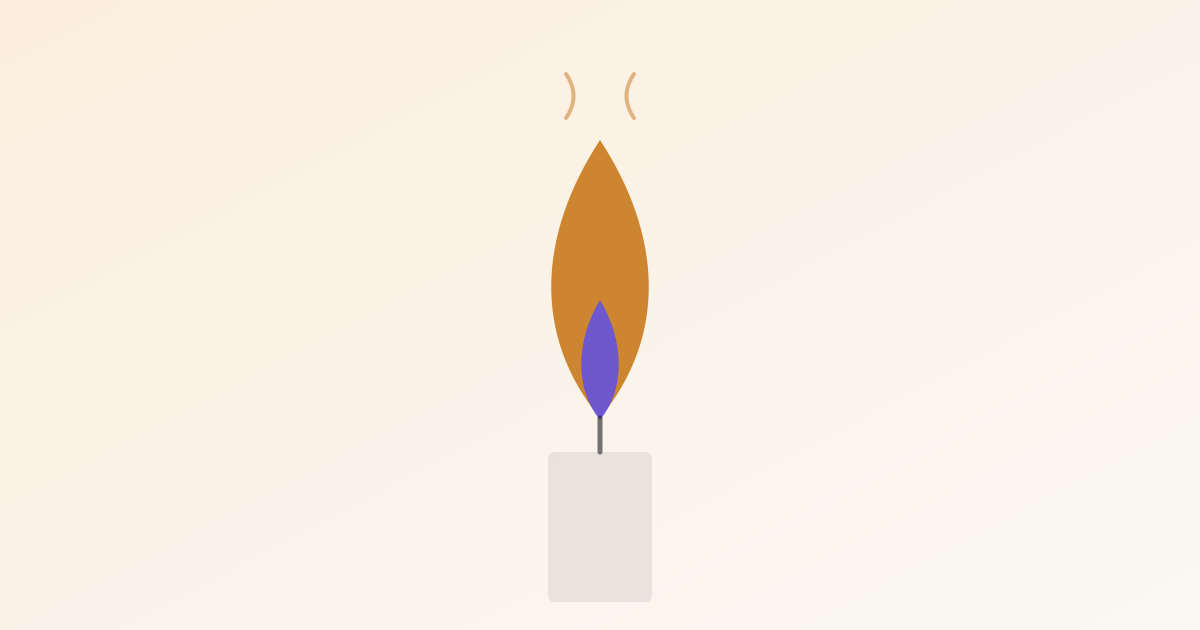
At the base sits a faint blue cone. That blue is light emitted by excited fragments of molecules caught mid-reaction — a specific, chemical glow. Above it swells the familiar yellow-orange teardrop, and that colour has an entirely different source: tiny flecks of unburnt soot, heated until they shine. They are simply hot things radiating light because they are hot — the very same effect that sets the colour of a star. A candle's yellow tip and a yellow star are, at bottom, the same trick at different scales.
A flame is warm enough to make its own light and fleeting enough that it exists only while it is fed. It is less like a stone and more like a wave — a shape held steady by a flow passing through it.
Blow gently across the top of the flame and watch it lean, and then recover. You are not shoving a thing aside. You are disturbing a reaction and watching it re-settle — a small, bright accident of chemistry that has to be remade, atom by atom, every instant it stays alight.