How a Glowing Coal Broke Classical Physics
A whodunit, in which the victim is classical physics and the murder weapon is a warm lump of coal.
The scene of the crime
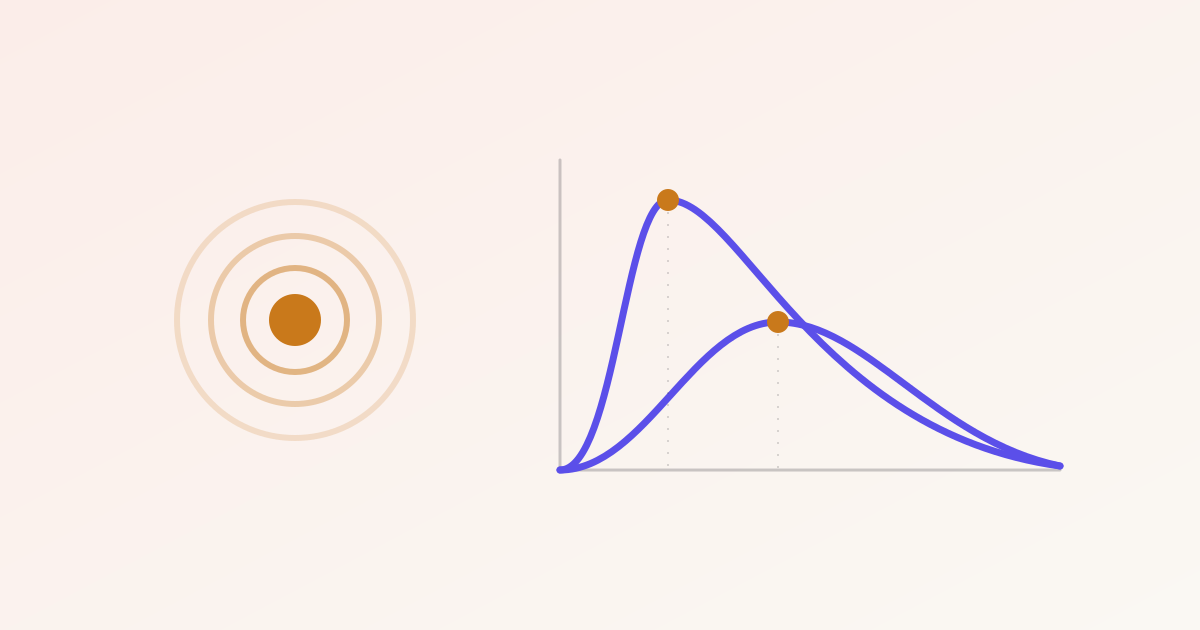
Heat anything up and it glows. A coal in a dying fire goes dull red; a kiln runs orange; a welding arc burns blue-white. The color is a thermometer — the hotter the object, the bluer its glow — and explaining it should have been a routine case. By 1900 physicists could measure the exact spectrum a hot object emits: how much energy pours out at each wavelength. The curve is a smooth hump, peaking at one wavelength and tailing off to either side.
Reproducing that hump with the trusted laws of the day should have been easy. It was a disaster.
The catastrophe
Classical physics modeled the glow as countless tiny vibrating modes, and a rock-solid principle — equipartition — insisted every mode gets the same average share of energy. The trouble: there is no limit to how short a wavelength can be, so there are infinitely many short-wavelength modes. Hand each an equal slice and the predicted energy climbs without bound toward the blue end and beyond, into the ultraviolet.
Taken at face value, the theory said every warm object — this page, your own body — should be blasting out an infinite torrent of ultraviolet and X-rays. Open the oven door and be vaporized. Physicist Paul Ehrenfest named it the ultraviolet catastrophe, and the maddening part was the suspects: the equations came straight from the era's most reliable laws. The math was honest. The answer was insane.
The reluctant culprit
Enter Max Planck, in 1900 — a deeply conservative physicist, the last man who wanted a revolution. To force the formula to match the real, finite curve, he tried a trick he didn't believe in. Suppose the vibrating modes can't emit energy in any amount they like. Suppose energy comes only in discrete chunks — quanta — each of a size proportional to frequency: E = hf.
Watch what that does. A high-frequency (short-wavelength) mode can only get going if it can afford its first quantum, and that quantum is big. A merely warm object hasn't got that much energy to hand any single mode, so those modes stay dark — frozen out, unable to pay the entry fee. The infinite ultraviolet blaze never happens. The curve bends back down, and it fits the measurements perfectly.
The constant h Planck had to introduce is fantastically small — about 6.6 × 10⁻³⁴ in standard units — which is why we never notice the lumpiness in everyday life.
The twist
Here's what makes it a proper mystery: Planck thought he'd found a bookkeeping trick, not a law of nature. He called it "an act of desperation" and spent years trying to explain the quanta away. He never managed it. In 1905 Einstein took the lumps literally — real packets of light — and the accidental fix became the founding clue of quantum theory, the first hint of light's split personality.
That same hump, it turns out, is how we read the sky: the peak wavelength of a star's glow betrays its surface temperature, letting us take a star's temperature from its color. The same curve runs cooler and closer to home: a warm planet like ours glows in the infrared, and whether that glow escapes to space or is sent back down sets the temperature you live at. A solved case with the widest possible reach — and a culprit who never wanted the credit.