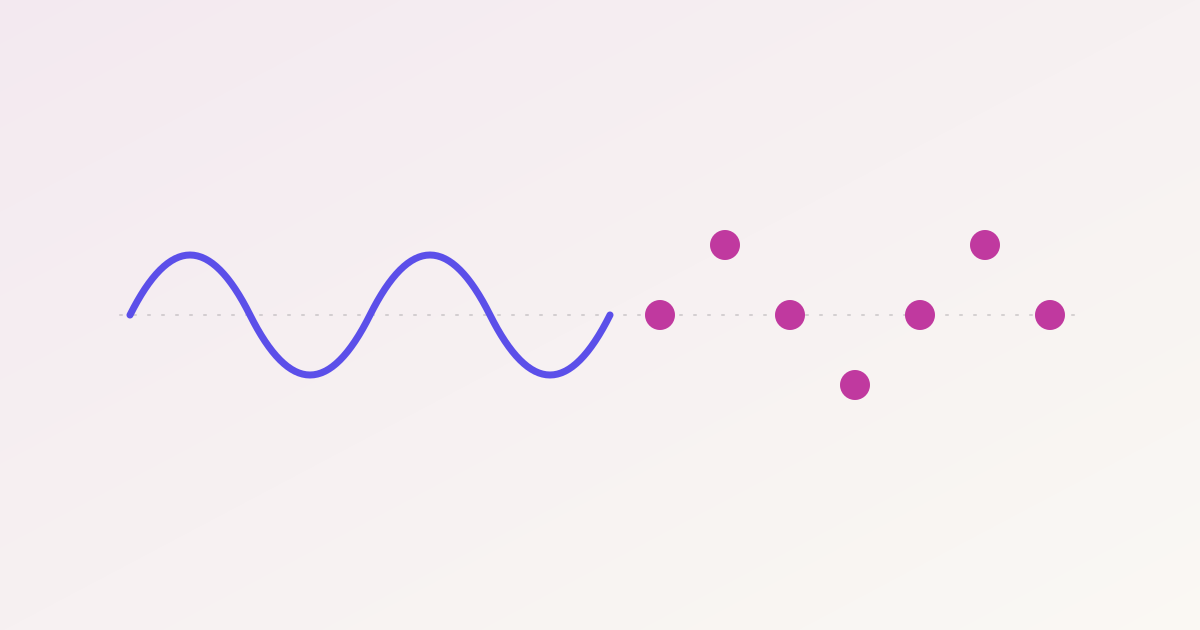
Wave or Particle? Yes.
Ask whether light is a wave or a particle and you'll get the most annoying answer in physics: yes. Not "a bit of both," not "depends on your mood" — yes, fully, to a question that turns out to be badly posed. Here's how we backed ourselves into it.
A three-century argument
Newton, around 1700, was sure light was a hail of tiny corpuscles — particles. His rival Huygens insisted it was a wave. For a hundred years Newton's fame kept the particle camp ahead.
Then in 1801 Thomas Young sent light through two narrow slits and got a striped pattern of bright and dark bands on the far wall. Only waves do that: two waves overlap, crest meets crest to brighten, crest meets trough to cancel. Waves had won. By the 1860s Maxwell had even named the kind of wave — ripples in the electric and magnetic fields. Case closed, or so it felt.
The case reopens
The wave picture cracked from two directions at the turn of the century. A glowing object's spectrum made no sense unless light's energy arrived in discrete lumps — the puzzle that broke classical physics. Then Einstein explained the photoelectric effect (light knocking electrons out of metal) by taking those lumps seriously: light comes in packets, photons, each carrying a fixed quantum of energy. Particles again — but now particles that also, somehow, interfere like waves.
The twist came in 1924 from a French graduate student. Louis de Broglie asked the obvious-in-hindsight question: if waves can act like particles, can particles act like waves? He gave matter a wavelength. Three years later, electrons fired at a crystal came out in a diffraction pattern — the very striped signature Young had seen with light. Electrons, the most particle-like things we knew, were diffracting.
| Thing | Acts like a wave when… | Acts like a particle when… |
|---|---|---|
| Light | spreading through slits, interfering | landing on a detector, ejecting an electron |
| Electron | traveling, diffracting through a crystal | arriving as a single dot on a screen |
The words are the problem
So is it really a wave or really a particle? The honest answer is that it is neither, because both words were coined by people throwing rocks and watching ponds. A quantum object is a third kind of thing — older and more fundamental than either picture — and our everyday language simply never needed a word for it.
"Wave" and "particle" are two shadows the same object casts, depending on which lamp you switch on. Set up the experiment to ask a wave question and you get wave behavior; ask a particle question and you get a particle answer. You never catch it being both in the same breath — a tension dramatized one electron at a time.
Duality isn't a paradox the universe needs to resolve. It's a mismatch between what light is and the two small boxes we keep trying to fit it into.
Wave or particle? Yes. The better question is what kind of thing has waves and particles for shadows — and getting comfortable with not having an everyday word for the answer.