The Double-Slit Experiment, One Particle at a Time
Fire them one at a time. That is the whole trick, and the whole problem.
The setup
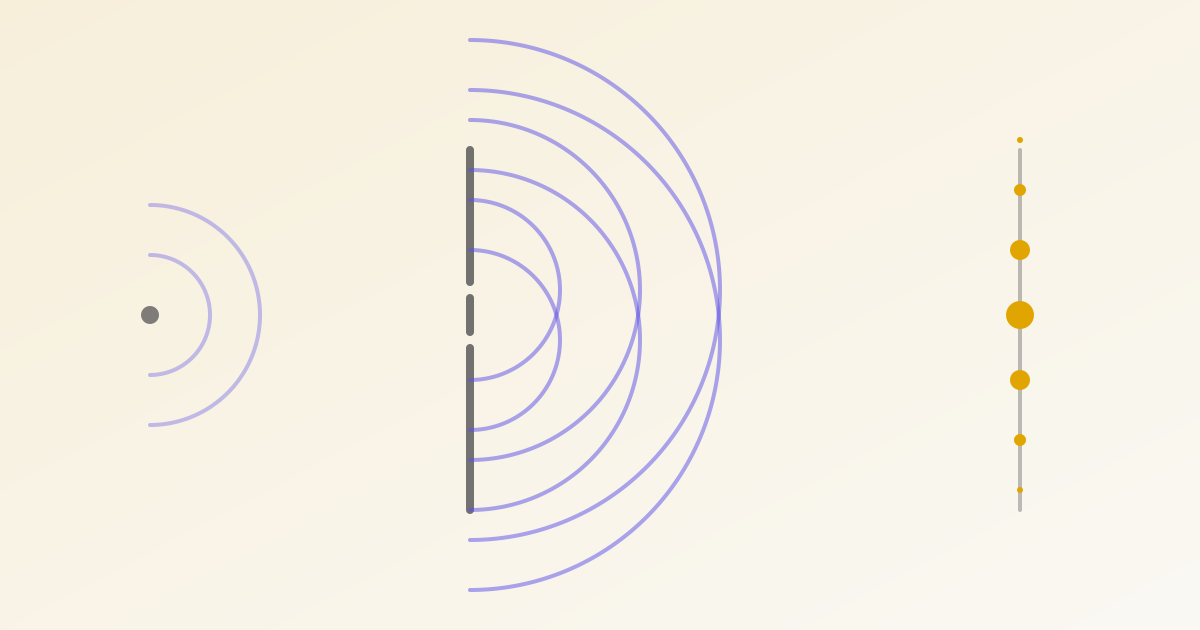
A source. A solid wall with two narrow vertical slits cut close together. Behind it, a screen that records a tiny dot wherever something strikes. We will send electrons at the wall — but slowly, deliberately, one electron at a time, so slowly that each has left its mark before the next is even born. Whatever happens, no electron can be jostling another. Each is utterly alone.
Let's begin.
One dot at a time
The first electron crosses, and the screen blinks a single point. Good — a particle, a little bullet, landed somewhere behind one slit or the other. The next lands elsewhere. Then another. Each a clean, lonely dot. Nothing strange. This is what particles are supposed to do.
We keep firing. Hundreds. Thousands. And as the dots pile up, something surfaces in them — not a smear, not the two tidy stripes you would expect from bullets through two gaps, but a row of evenly spaced bands: bright, dark, bright, dark, fading out to the sides.
That is an interference pattern — the signature of two waves overlapping, crests and troughs adding and cancelling. But there are no waves here. There were never two of anything. Each electron arrived alone, as a single dot. The pattern was built up one isolated particle at a time.
The unease sets in
Read that again, because it is the splinter you cannot pull out. The bands only make sense if each electron somehow went through both slits and interfered with itself — arriving as one dot, yet steered by a blend of two routes it took together. That is superposition made visible, and it is the price of admission.
Don't believe it? Close one slit. The bands vanish at once, replaced by a single plain blob behind the open gap. So each lone electron "knew" whether the other slit — the one it supposedly never used — was open or shut. Both slits shape where a single particle is allowed to land.
So we do the obvious thing. We set a detector at the slits to catch each electron in the act and see which one it really takes.
It works. Every electron is caught cleanly at one slit or the other — never both.
And the bands disappear.
The moment we extract which-path information, the interference is gone and the screen shows two ordinary blobs. Bullets again. We did not have to strike the electrons hard; merely knowing the route — letting the world keep a record of it — is enough to erase the pattern. Look, and it is particles. Don't look, and it is something with no honest name, neither ball nor wave but something our two words cannot hold.
Living with it
This is the experiment Richard Feynman called the only mystery of quantum mechanics — the one that "has in it the heart" of the whole subject.
And that recording detector hides one more turn of the screw: to register the path, it must become tied to the electron itself, its fate tangled with the particle's. Pull on that thread, and the unease only spreads.