Superposition, Honestly
The word does a lot of heavy lifting in headlines. Let's lighten the load.
What the headline says
You have read it a hundred times: a particle is "in two places at once," a qubit is "both 0 and 1 at the same time." It sounds like the particle is leading a frantic double life, doing two contradictory things simultaneously. That picture will mislead you. Here is an honest one.
What superposition actually is
A quantum system is described by a state — and states can be added together. If "spinning up" is allowed and "spinning down" is allowed, then a specific blend of up and down is also a perfectly good, single, definite state. That blend is a superposition.
Two things it is not:
- Not "secretly one of them, and we just don't know." That would be ordinary ignorance, like a coin hidden under your hand. Superposition is different, and we can prove it, because superposed possibilities can cancel each other out — and plain ignorance never does. Fire particles at two narrow slits and the "through the left" and "through the right" possibilities interfere, leaving dark stripes where a hidden-but-definite particle could perfectly well have landed. Ignorance cannot carve out those stripes. Interference can.
- Not "showing both values at once." When you actually measure, you get exactly one result — one place, one 0-or-1 — never a blurry both. What the superposition sets is the odds of each outcome, fixed by how much of each state went into the blend.
So the plural thing is not the particle. It is the list of possible outcomes. The state itself is single and sharp; it is our questions that have several answers.
The honest catch: it depends what you ask
Here is the part the headlines skip. Whether something is "in a superposition" depends on the question you ask.
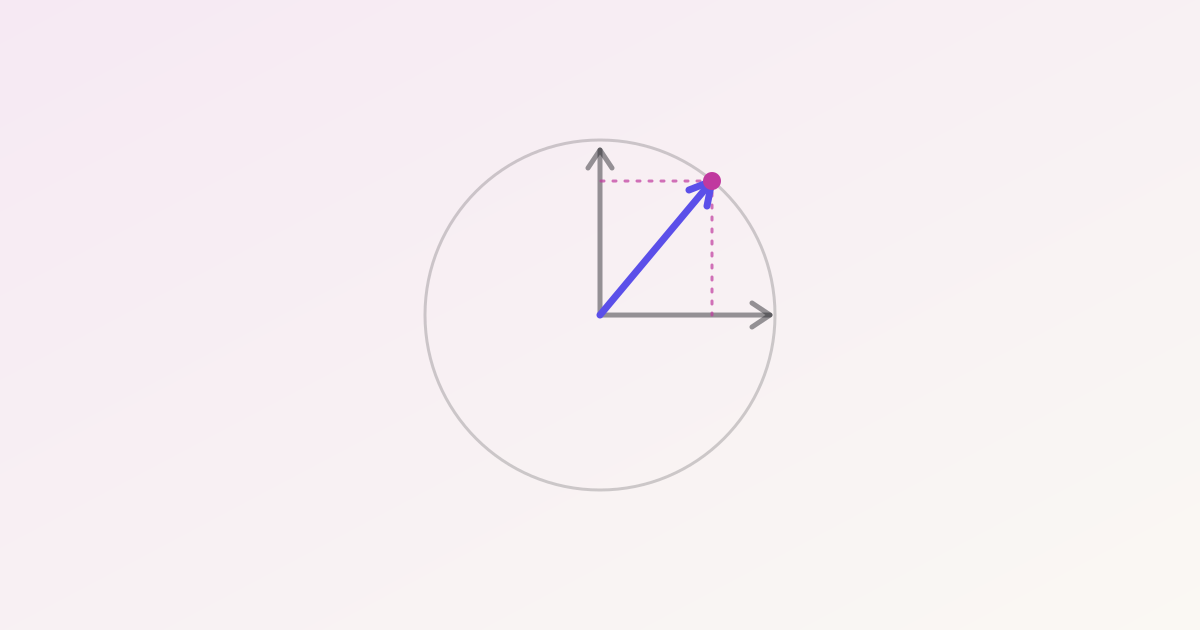
A state that is a 50/50 blend of up and down along one axis is, viewed along a different axis, a single definite answer — fully "up" that way, no blend at all. Nothing about the particle changed; you simply asked a different question. Superposition is not a property a thing carries on its own. It is a relationship between the state and the measurement you choose.
This is also why you cannot be sharp about everything at once: pin a particle to a definite value of one quantity and it is forced into a spread of others. That trade-off has a name and a reputation.
"Two states at once" is shorthand, and a leaky one. The mathematics is a single, definite state. What is genuinely plural is only the set of results a measurement could produce — and their probabilities.
Why bother being careful
Because the sloppy version smuggles in magic the real thing does not have. Superposition does not let a particle occupy contradictory states; it lets possibilities combine and interfere before a measurement forces one of them to happen. Scale that same question up from a lone particle to a cat in a sealed box and it becomes the most famous thought experiment in physics — a trap Schrödinger set, not a mascot he cheered for. Stretch the idea across two particles instead and you get a shared, spookier version — even easier to mythologize, and even more worth getting right.