The Uncertainty Principle Is About Waves, Not Clumsy Measuring
There's a story everyone hears first, and it's wrong.
The story goes: to find out where an electron is, you have to hit it with something — a photon, say — and that little kick shoves the electron off course. So the act of looking disturbs what you're looking at, and that's why you can't pin down a particle's position and its momentum at the same time.
Tidy. Memorable. Not the uncertainty principle.
The myth: clumsy measurement
Disturbance is real enough — bouncing light off a tiny thing really does jostle it, and Heisenberg himself reached for this "microscope" picture early on. But if that were the whole story, the limit would be a mere engineering problem: build a gentler probe and do better. The principle says no gentler probe will help — not because our hands are clumsy, but because a particle simply does not have a sharp position and a sharp momentum simultaneously. There is nothing precise sitting there to be disturbed.
The real reason: it's a wave thing
Here's the move that fixes everything. In quantum mechanics a particle is described by a wave, and its momentum is encoded in that wave's wavelength — shorter wavelength means more momentum. Now put two questions to any wave:
- Where is it? A wave of one pure wavelength is an endless, identical ripple — the same everywhere. Perfectly sharp wavelength, no location at all.
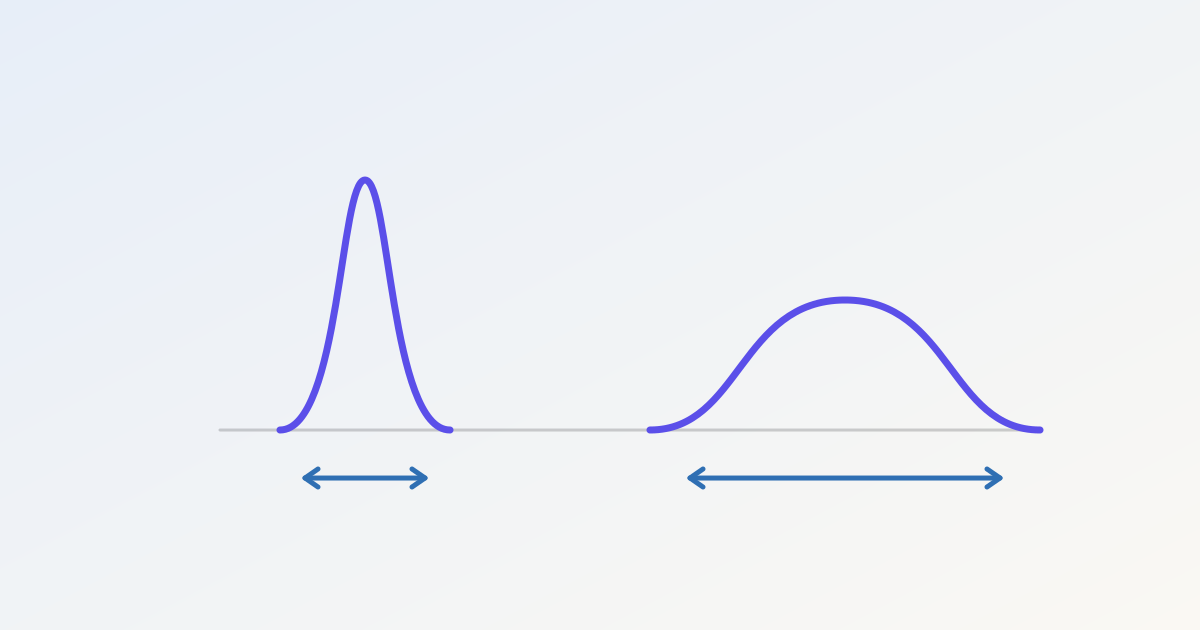
- What's its wavelength? To bunch a wave into a single spot — a localized "packet" — you must add together many different wavelengths. Sharpen the position and the wavelength smears.
You cannot have both at once. A definite position demands a spread of wavelengths; a single wavelength demands no definite position. That trade-off is built into the mathematics of every wave in the universe, quantum or not.
You've already met it
Musicians live with this daily. A pure, single-pitch tone has to ring on and on; a sharp click lasts almost no time but contains a smear of many frequencies at once. There is no such thing as a tone that is both perfectly pitched and instantaneous. Same trade — just time-and-frequency standing in for position-and-momentum. Audio engineers call it the time–bandwidth limit and never once mention quantum spookiness.
The quantum version, written Δx · Δp ≥ ℏ/2, is that very theorem wearing a physicist's hat. The only quantum ingredient is the fact that matter is wavelike at all — the discovery at the heart of matter's wave nature. Once a particle is a wave, uncertainty is just Fourier mathematics: unavoidable and exact.
So what does it actually forbid?
Not knowledge you could have gathered with a steadier hand — knowledge that was never there to begin with. A particle in a state of definite momentum is genuinely spread across space, a blend of countless positions at once. Pin it down to a point and you have thrown away any single answer to "how fast?" Nature isn't concealing the other number behind your clumsy thumb. It hasn't chosen one.
The uncertainty isn't in the measurement. It's in the question — you asked a wave to behave like a billiard ball.