Spin: The Electron Is Not Spinning
Two graduate students proposed it, then did the arithmetic that seemed to kill it and tried to call the paper back. It was already at the printer.
The little top that can't be
Every electron behaves as though it is spinning. It carries angular momentum — the bookkeeping quantity of rotation — and it acts like a minuscule bar magnet, exactly what a whirling ball of charge should. So the obvious picture is a tiny top turning on its axis. Hold onto it for one more paragraph, because it is about to break.
In 1925 two young physicists in Leiden, Samuel Goudsmit and George Uhlenbeck, proposed precisely that top to explain a stubborn doubling in the lines of atomic spectra. Their mentor Paul Ehrenfest sent the paper off — and then the elder statesman Hendrik Lorentz worked the numbers. For a ball the size the electron was thought to be to hold that much angular momentum, its surface would have to move many times faster than light. The students hurried to withdraw the paper. Too late; it was already in press. Ehrenfest told them they were young enough to afford a blunder.
It wasn't a blunder. It was right about the physics and wrong about the picture.
What survives, and what doesn't
The angular momentum is real. It is conserved, it adds and cancels with the orbital motion of electrons in an atom, and it visibly deflects atoms in a magnetic field. Otto Stern and Walther Gerlach had, back in 1922, fired a beam of silver atoms through a lopsided magnet and watched it split cleanly in two — not smear into a band, but part into an "up" beam and a "down" beam with nothing in between.
What does not survive is the turning. As far as anyone has ever measured, the electron is a point: no radius, no surface, nothing there to rotate. Spin is angular momentum with no motion beneath it — an intrinsic property, as basic as charge or mass, that the electron simply has. The word is a fossil of the first wrong guess, and we are stuck with it.
There is no smaller thing inside the electron going around. "Spin" names a real, measurable rotation of nothing at all — angular momentum that was never anybody's spinning.
Why it runs your world
In 1928 Paul Dirac merged quantum mechanics with special relativity, and spin fell out of the equations unbidden — not added by hand but demanded. Its consequences are anything but subtle. Because electrons carry half-integer spin, no two of them may occupy the same state — Wolfgang Pauli's exclusion rule — so an atom's electrons stack into shells instead of all collapsing to the lowest one. That stacking is the shape of the periodic table, the reason matter is solid and your hand doesn't slide through the desk, and the origin of everyday magnetism. Measured along any axis, the answer is always the same size — "up" or "down," the ±½ of Stern's split beam, and the very two answers a pair of entangled electrons are sworn to give oppositely.
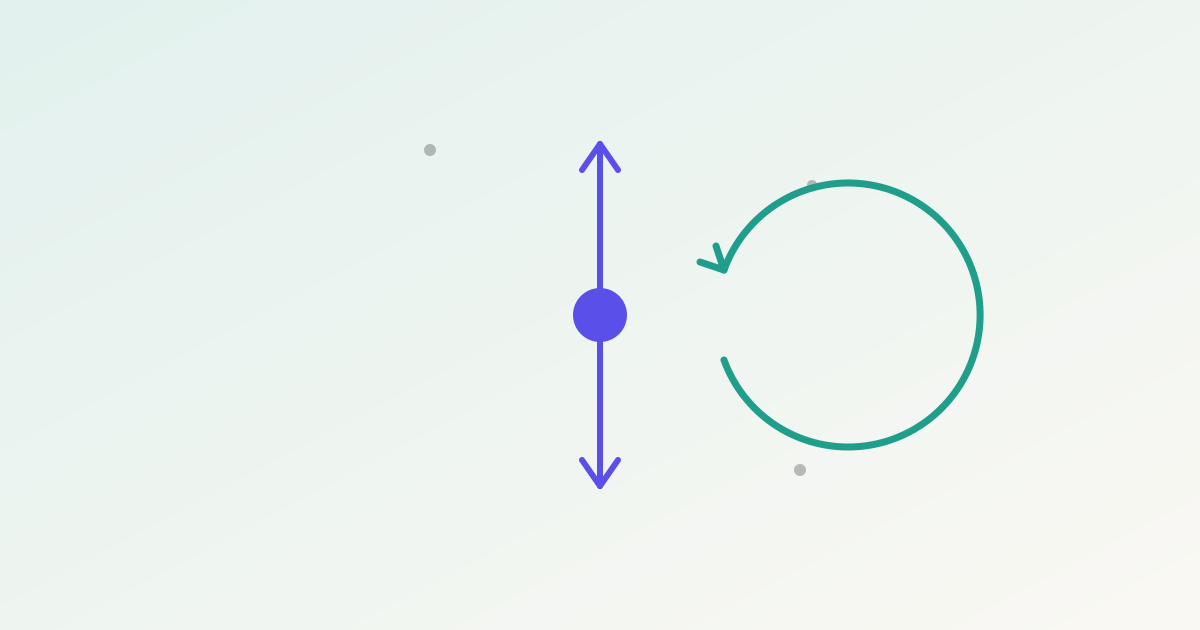
There is one final insult to intuition. Rotate a spinning top all the way around, 360°, and it looks exactly as it did. Rotate an electron's spin a full circle and it comes back changed — inverted. Only a second full turn, 720° in all, sets it right. Whatever spin is, it does not live in our world of tops and turning. It is its own thing, wearing a borrowed name.