Why the Periodic Table Has That Strange Shape
The periodic table isn't a chart someone designed to look tidy. Its shape was forced on us by the atom.
A map of electrons
Every box on the table is an element, and each differs from its neighbor by one proton — and one electron. The table's whole architecture, the blocks and the gap and those two marooned rows at the bottom, is a picture of where those electrons go.
Electrons don't circle the nucleus like planets. They occupy orbitals — fuzzy, standing-wave clouds where an electron is genuinely smeared across many places at once. Orbitals come in families labelled s, p, d, and f, and they fill in a strict order set by energy. Two rules do most of the work:
- An orbital holds at most two electrons, and those two must spin in opposite directions.
- Electrons fill the lowest-energy orbitals first.
Why the blocks have the widths they do
Each family offers a fixed number of orbitals, so each can hold a fixed number of electrons — and that count is exactly the width of its block:
| Block | Orbitals | Electrons | Columns wide |
|---|---|---|---|
| s | 1 | 2 | 2 |
| p | 3 | 6 | 6 |
| d | 5 | 10 | 10 |
| f | 7 | 14 | 14 |
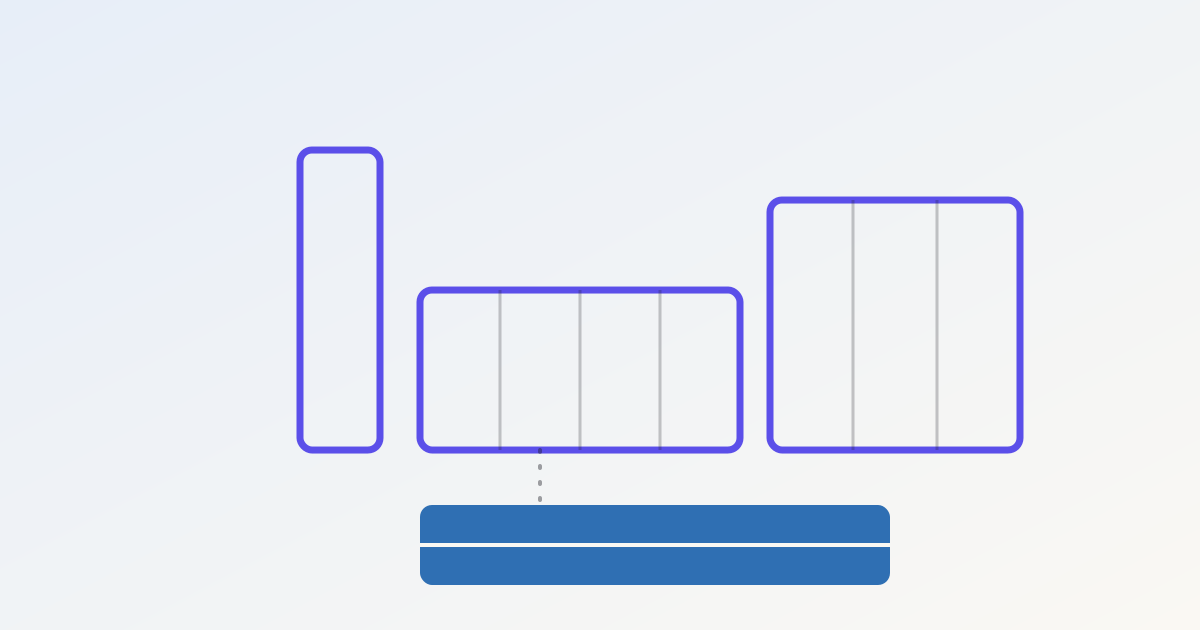
So the slim s-block on the left is two columns. The p-block on the right is six. The broad transition-metal slab through the middle is ten. The shape is just arithmetic about orbitals.
The rows, the gap, and the exiles
Rows are periods, and a new one begins each time electrons start filling a fresh shell.
- The first row holds only two elements, hydrogen and helium, because the first shell offers a single s orbital — room for two electrons and no more.
- The central gap in the second and third rows is there because d orbitals don't begin filling until the fourth row. It's a quirk of energy ordering: the 4s level fills before the 3d, so the transition metals arrive "late." That delay is the notch you see.
- The two rows exiled beneath the table — the lanthanides and actinides — are the f-block. They really belong tucked between the s- and d-blocks, but the f-block is fourteen columns wide. Splice it back in and the table grows too wide for any page, so we lift it out and set it underneath.
Read the table left to right, top to bottom, and you are reading the order in which electrons stack into atoms. Elements share a column because they share an outer-electron arrangement — and the outer electrons are the ones that decide how an atom bonds. That's why chlorine and fluorine behave alike: their electrons are arranged alike.
The strange silhouette isn't decoration. It's the shape the quantum rules carve.