How Atoms Stick Together
Everything you have ever touched is held together by one of a handful of tricks, and not one of them is glue.
Ask why a molecule stays a molecule and the schoolroom answer is that atoms "want" a full outer shell of electrons. It is a useful fiction and a misleading one. Atoms want nothing. A bond forms for the same reason a ball rolls into a valley: the joined arrangement sits lower in energy than the separated one, and physical systems slide toward lower energy whenever a path lets them. The full-shell rule is only a rough map of where the deepest valleys happen to lie.
That reframing fixes a second, more stubborn error. People say energy is "released when bonds break" — in a fire, in food, in a battery. It is exactly backwards. Pulling a bond apart always costs energy; you are dragging the ball back up out of its valley. Energy comes out only when new bonds form, and a reaction runs hot only when the bonds it makes are deeper valleys than the ones it broke. A candle burns because the bonds in carbon dioxide and water are stronger than the ones in wax and oxygen, and the surplus leaves as heat and light.
So a chemical bond is not an object wedged between two atoms. It is a name for electrons having found a cheaper place to sit — and the electrons that do the sitting are the outermost ones, which is exactly why an element's column in the periodic table predicts how it bonds. There are only a few ways they manage it.
The catalogue
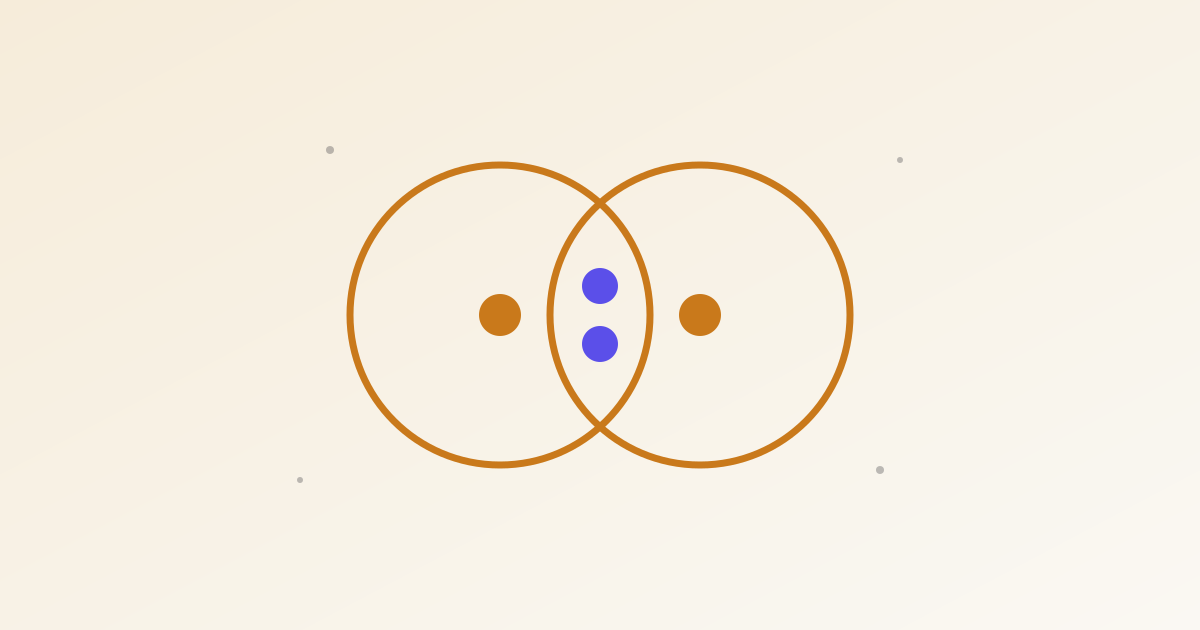
Covalent — two atoms share a pair of electrons, each nucleus pulling on the same pair. Gilbert Lewis sketched this shared-pair picture in 1916, years before anyone could say why it worked. It is the strong, directional bond that builds molecules: the O–H of water, the backbone of every protein, the entire rigid lattice of a diamond.
Ionic — one atom hands an electron over outright, and the two leftover ions, now oppositely charged, grip each other. Table salt is nothing but a checkerboard of sodium that gave and chlorine that took.
Metallic — the atoms pool their outer electrons into a shared sea and sit as bare ions bathed in it. That roaming charge is why metals conduct, bend without shattering, and shine — and the same crowd of electrons, refusing to be squeezed, helps hold the solid rigid.
Hydrogen — a hydrogen atom already committed to one bond still has a little pull left over to reach for a neighbour's spare electrons. Any single one is feeble, but in bulk they run the world: they are what makes water strange, and what clips the two strands of DNA together loosely enough to be unzipped and read.
Van der Waals — the faintest of all, a flickering attraction between the momentary lopsidedness of any two clouds of electrons. It is why a gecko can walk up glass, and why nitrogen, tugged by nothing stronger, condenses to a liquid only when brutally cold.
| Bond | What the electrons do | Rough strength |
|---|---|---|
| Covalent | shared between two atoms | strong |
| Ionic | handed over, then ions attract | strong |
| Metallic | pooled into a shared sea | strong |
| Hydrogen | a committed H reaches to a neighbour | about a tenth of a covalent bond |
| Van der Waals | fleeting, flickering pull | weakest of all |
A bond is not a rope knotted between two atoms. It is a bargain the electrons struck because it lowered the bill — and every bargain can be undone, for a price paid back in energy.
That price is the whole story. Fire, weather, digestion, and the battery in your pocket are one transaction run over and over: bonds broken at a cost, better bonds formed at a profit, and the difference handed out as the warmth and motion of the world.