Water Is the Strangest Liquid You Drink
Water is so ordinary we forget it breaks rules that other liquids obey.
Pour a glass and you are holding one of the most anomalous substances in chemistry. Next to liquids built from similar small molecules, water gets almost everything "wrong" — and nearly every oddity traces back to a single feature: the hydrogen bond.
One bond behind it all
A water molecule is bent, and oxygen pulls the shared electrons toward itself. That leaves a lopsided little object:
- The oxygen end is slightly negative.
- The two hydrogens are left slightly positive.
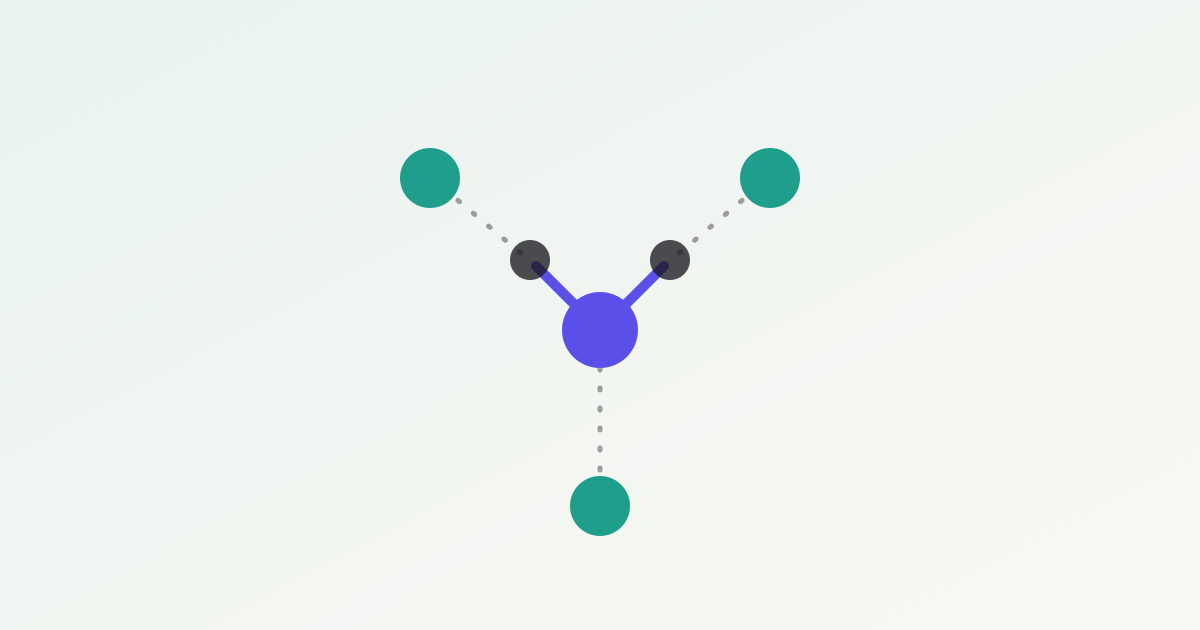
- Opposite charges attract, so the hydrogen of one molecule reaches out and grabs the oxygen of the next.
That reach is the hydrogen bond — the weakest of the ways atoms hold together. Any single one is feeble — roughly a tenth as strong as the bonds holding the molecule itself together. But each water molecule can make up to four at once, and that web of weak links is what makes water strange.
The list of anomalies
| What water does | Why the hydrogen bond does it |
|---|---|
| Ice floats | Freezing locks molecules into an open, roomy lattice, so solid water is less dense than the liquid |
| Resists temperature change | Heat first goes into stretching and snapping bonds, not into speeding molecules up |
| Beads up and holds a water strider | Surface molecules are tugged inward, giving an unusually taut surface |
| Climbs up a tree | Molecules cling to each other and to narrow tubes, hauling water upward against gravity |
| Stays liquid in your kitchen | Its chemical lookalikes boil far below 0 °C; hydrogen bonds keep water liquid up to 100 °C |
Take ice. Almost every other substance is denser as a solid and sinks in its own melt. Water expands by about 9% when it freezes, because the bonds force its molecules into a spacious hexagonal cage. So ice floats — which is why ponds freeze from the top down and fish survive the winter underneath. And the same hydrogen bonds that leave ice's surface molecules loosely held — with no neighbours above them to grab onto — are part of why ice turns out to be so treacherously slippery.
Or take water's stubborn temperature. It soaks up a lot of heat for only a small rise in warmth, because energy spent jostling and breaking hydrogen bonds isn't available to make molecules move faster. That one fact steadies the planet's climate, loads the oceans with thermal inertia, and lets a bead of sweat cool you down.
Always in motion
None of this is frozen in place. In liquid water the bonds form and break trillions of times a second as molecules tumble past one another. That ceaseless molecular shoving is the very motion that, scaled up to a visible speck, makes a grain of pollen jitter under a microscope — the twitch that proved atoms are real.
Strip the hydrogen bonds away and water would be a forgettable gas at room temperature. Keep them and you get oceans, weather, sap climbing trees, and the chemistry of life. The strangest liquid you drink isn't strange by accident — it's strange because of one small, sticky bond.