Entanglement Is Not a Telephone
Yes, it is real. No, you cannot text your friend on Mars with it. Both, I promise.
The fantasy
Somewhere in roughly every science-fiction franchise there is an "entangled communicator": wiggle a particle here, its partner twitches there, and two starships gossip instantly across a galaxy. It is a wonderful image. It is also, sorry, impossible — and the reason why is more interesting than the fantasy.
What is actually shared
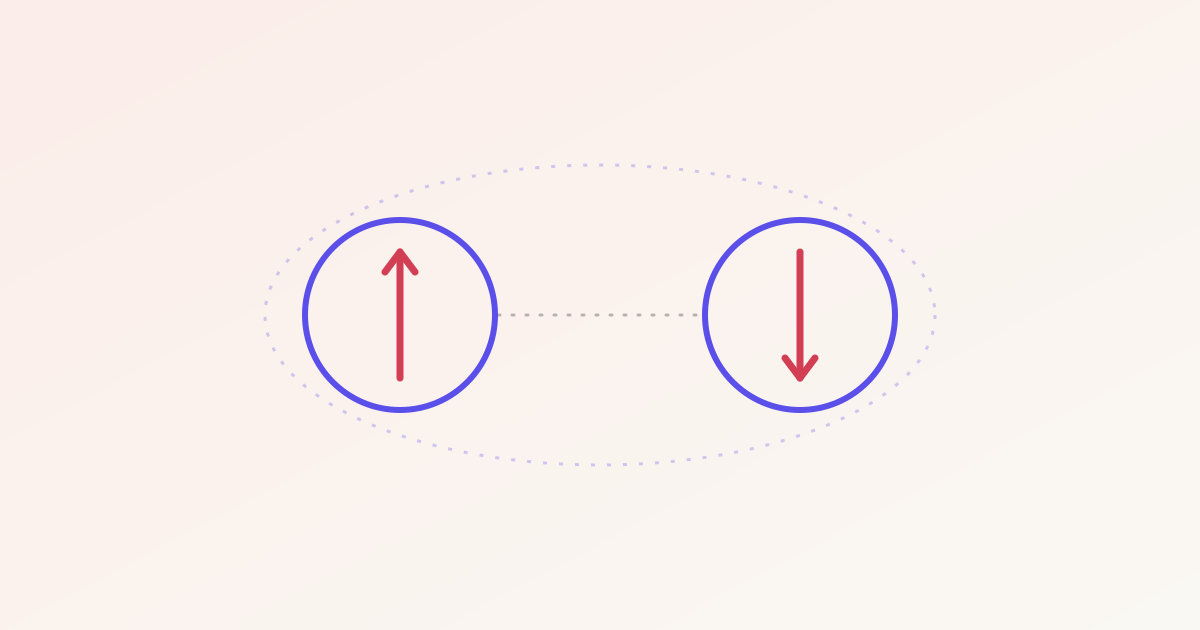
Take two particles and prepare them together so they form one joint superposition — a single shared state in which neither particle has a property of its own yet, but their future answers are locked together. The classic case: two electrons whose spins must come out opposite. Measure one and find it "up," and the other is now, with certainty, "down" — whether it sits in the next room or around the next star.
Einstein hated this. He called it "spooky action at a distance" and bet the spins were secretly settled all along, like a pair of gloves split between two boxes: open one, find the left glove, and you instantly "know" the other box holds the right. No spookiness — just hidden labels, agreed in advance.
He lost the bet. Experiments testing Bell's theorem show the correlations are too strong to come from labels fixed beforehand. The link is genuinely deeper than gloves in boxes.
Why it still is not a phone
So surely that is your faster-than-light telegraph? Here is the deflation:
- Your side looks like pure noise. Measure your particle and you get up, down, up, up, down — random, 50/50, every time. It looks exactly the same whether your distant partner has already measured, hasn't yet, or doesn't exist. You cannot tell, from your own results, that anything happened over there — and you cannot hide a message inside numbers that come out random no matter what you do.
- The magic only appears when you compare notes. The eerie correlation is real, but you can only see it by laying both lists of results side by side. And getting the other list to you means sending it the ordinary way — a phone call, a radio signal, a courier — all capped at the speed of light.
Put those together and you get the rule physicists call no-signalling: entanglement creates correlation, never communication. The glove analogy actually nails this half — you learn the far glove instantly, yet you cannot send anything by opening your box. Bell's result simply tells you the real thing is, underneath, far stranger than gloves.
Nothing — no particle, no signal, not one bit of information — crosses the gap faster than light. The correlation is instantaneous; the usefulness of it travels no quicker than a postcard.
So what is it good for?
Plenty — just not telegraphy. Entangled particles let you build encryption keys that expose any eavesdropper, and they power "quantum teleportation," which, despite the name, copies a quantum state across space and still needs a normal, light-speed message to finish. The classical channel is always there, quietly enforcing the speed limit.
It even shows up back at the two-slit screen: the instant a detector becomes entangled with a particle's path, the interference dies. It is the very mechanism that keeps Schrödinger's cat from ever being caught both alive and dead — a large object entangles with its surroundings far too fast for any such blend to survive. Same physics, same airtight bookkeeping. Spooky, yes. A telephone, never.