The Discovery That Won Einstein His Nobel
Everyone knows Einstein won the Nobel Prize. Almost everyone is wrong about what for.
The stubborn little effect
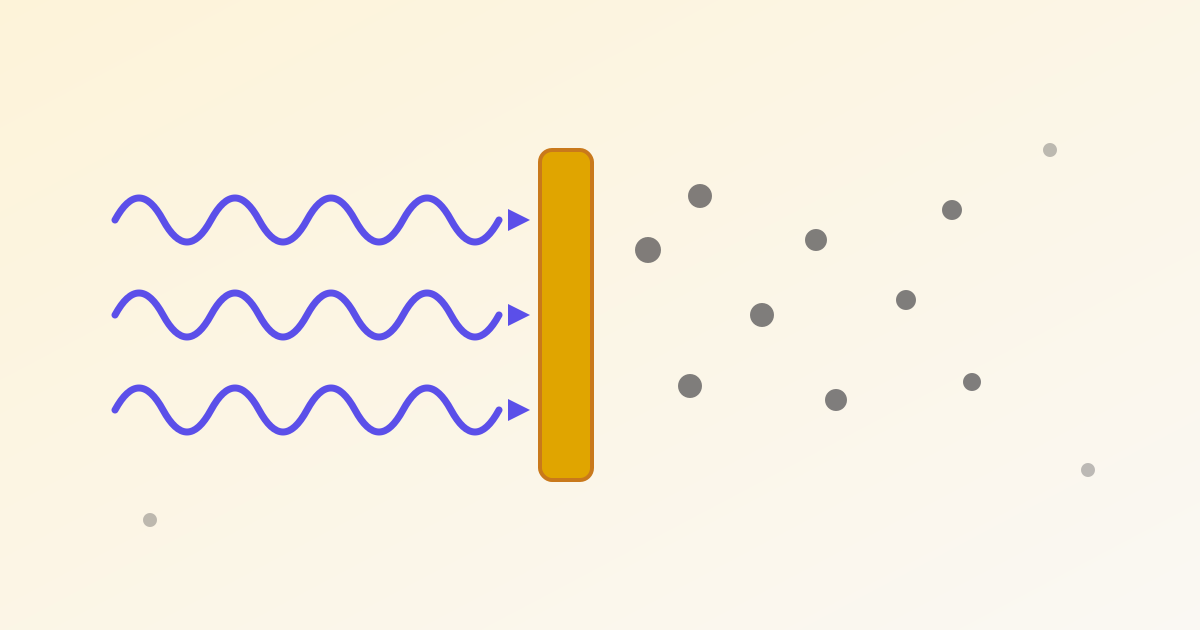
Shine light on a clean piece of metal and, if the light is right, electrons come squirting out. Heinrich Hertz stumbled on this in 1887 — awkwardly, since he was busy proving the opposite, that light is a wave, in the very experiments that confirmed Maxwell. A flicker of ultraviolet made the sparks in his apparatus jump more eagerly. He noted it and moved on.
By 1902 Philipp Lenard had measured what the effect actually does, and it made no sense:
- Make the light brighter and you get more electrons — but each one leaves with exactly the same energy as before.
- Make the light bluer (higher frequency) and the electrons come out faster, carrying more energy.
- Drop below a certain color and nothing happens at all — no electrons, however blinding the lamp, however long you wait.
Every one of those is backwards from how a wave should behave.
Why the wave picture chokes
For a wave, the energy lives in its brightness. So a bright lamp ought to knock electrons out harder than a dim one, and even a feeble light should work eventually, once enough has sloshed in to shake one loose. Neither happens.
Brightness only ever changes how many electrons come out. Color changes how fast. A wave has no reason to make that distinction — and light, it turns out, is not only a wave.
The most trusted picture of light could not explain the sparks in Hertz's own lab.
Einstein takes the lumps literally
In 1905, the same miraculous year he explained the jittering dust that proved atoms are real, a 26-year-old clerk in the Bern patent office offered a fix he modestly called "heuristic." Max Planck had recently supposed that a hot object gives off energy in discrete lumps, to escape the catastrophe of the glowing coal — but Planck thought the lumps were a bookkeeping trick. Einstein took them literally and went further: light itself is lumps. Each packet — a photon — carries an energy set by its frequency alone, E = hf, using the same fantastically small constant h.
Now the puzzle dissolves. One photon strikes one electron. If the photon's energy clears the price of escape, the electron flies free and keeps the change; if it falls short, nothing happens, however many too-small photons pile in. A bluer photon carries more, so a faster electron. A brighter light is simply more photons — more electrons, each with the same energy. Threshold, frequency, instant response: all of it in one sentence. It was Newton's old particles of light, back from the dead with an equation attached — the opening move of light's long identity crisis.
The skeptic who proved it
Hardly anyone believed him, and the most useful disbeliever was Robert Millikan. Certain the photon was nonsense, Millikan spent a decade building exquisite experiments to bury Einstein's equation — and confirmed it to the decimal instead, pinning down h in the bargain. He accepted the result while still grumbling about the idea behind it.
By 1921 the effect was beyond dispute. So the Nobel committee, still skittish about relativity, handed Einstein his prize "for his discovery of the law of the photoelectric effect" — and breathed not a word about the theory that had made him a household name. The most celebrated physicist alive won his only Nobel for his quietest idea: that a beam of light is a hail of tiny, countable things.
You can watch them work on any sunny roof. A solar panel is Hertz's metal and Einstein's photons, industrialized — light knocking electrons loose, one countable packet at a time. And those same countable photons, coaxed into triggering one another in perfect step, are what pour out of every laser.