How a Laser Gets Its Light to March in Step
A laser pointer and a flashlight both make a spot of light. Only one of them can be bounced off a mirror on the Moon and still come back as a spot.
Not just a tidy flashlight
The easy assumption is that a laser is ordinary light, only brighter and aimed more carefully. It isn't. The light itself is a different kind of thing.
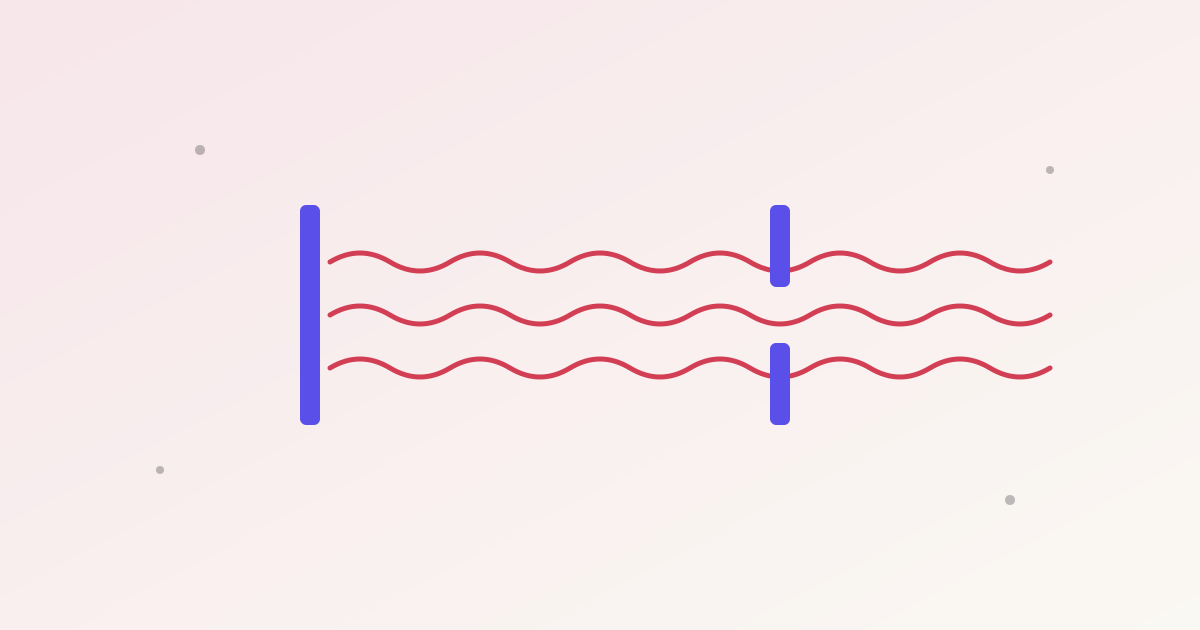
Light from a bulb or the Sun is a jumble: many colours mixed together, waves rising and falling out of step, spilling in every direction. Laser light is the opposite — a single pure colour, every wave crest lined up with every other, all travelling the same way. Physicists call it coherent. That lockstep is the whole trick, and it's what lets a laser hold a tight beam across a room, slice through steel, or carry a phone call down a glass fibre.
Einstein's forty-year-old prediction
To get light marching in step, you have to make the atoms emit it in step — and the mechanism was worked out on paper long before anyone had the hardware.
An atom holds its electrons on specific energy rungs. Kick an electron up a rung and, left alone, it will drop back down at some random moment and spit out a photon in a random direction. That's ordinary spontaneous emission — the light of every flame and filament.
In 1917 Einstein noticed a second possibility. If a photon of exactly the right energy sweeps past an atom that is already excited, it can coax the electron to drop early — and the photon that comes out is an identical twin of the one that triggered it: same colour, same direction, same phase, marching in step. This is stimulated emission, and it is the heart of the word LASER — Light Amplification by Stimulated Emission of Radiation. One photon becomes two, those two trigger two more, and an avalanche of identical light builds.
Every atom involved emits a photon that is a perfect copy of its neighbour's. A laser isn't bright light. It's a crowd of atoms all singing the exact same note, at the exact same instant.
Making the avalanche run
Two ingredients turn the idea into a device. First, you need more atoms excited than resting — a population inversion — or the photons get absorbed as often as they're copied. You force it by pumping energy in, with a flash lamp or an electric current. Second, you stand a mirror at each end, making a resonant cavity in which the swelling swarm of photons bounces back and forth through the excited atoms, multiplying on every pass. One mirror leaks a little, and the trickle that escapes is the beam.
The idea leans on the same quantised energy rungs that already explained why a photon's energy is fixed by its colour and rescued physics from the catastrophe of the glowing coal. Photons, being gregarious, will happily crowd into one shared state — a freedom that electrons find only by pairing off first. Einstein's stimulated emission then sat as a theoretical curiosity for over forty years, until 1960, when Theodore Maiman coaxed the first real flashes out of a rod of ruby.
You own a dozen of these now. Every one is billions of atoms, briefly convinced to sing in unison.