Resonance
Push a child on a swing and you already know the secret. You don't shove harder to go higher. You time each push to the swing coming back — a small nudge at the same moment, over and over — and the arc climbs on its own.
The gentle push that wins
Every object that can move has a rhythm it prefers. A swing, a guitar string, a wine glass, a skyscraper, a bridge — flick it and it wobbles at a rate set by its own size, stiffness, and weight, and no other. Physicists call that rate its natural frequency. Tap a wine glass with a fingernail and the note you hear is that frequency, the glass ringing at the one pitch it knows.
Resonance is what happens when you push a thing at exactly its own rhythm. Each nudge arrives in step with the motion already there, so instead of fighting it, every push adds a little more energy — and the little bits pile up. The swing that takes an ounce of effort per push climbs to a frightening height. That is the whole trick, and its power is that it accumulates: a feeble force, applied in perfect time, beats a strong one applied carelessly. Get the timing wrong — push while the swing is coming back toward you — and you take energy out, and the motion dies.
The catch is that the window is narrow. Nudge a hair too fast or too slow and your pushes drift out of step, sometimes helping and sometimes hindering, and the pile-up never happens. How narrow that window is has a name too — the Q of the system — and a high-Q thing is both fussier about frequency and better at hoarding what it collects. A wine glass rings for seconds after a tap (high Q, very choosy); a car door gives a dead thunk and nothing more (low Q, indifferent). Sing the glass's exact note, loud and sustained, and you are pushing the swing again — the rim flexes a little further each cycle until, if you hold the pitch, it flexes past what glass can bear, and shatters.
Only certain notes fit
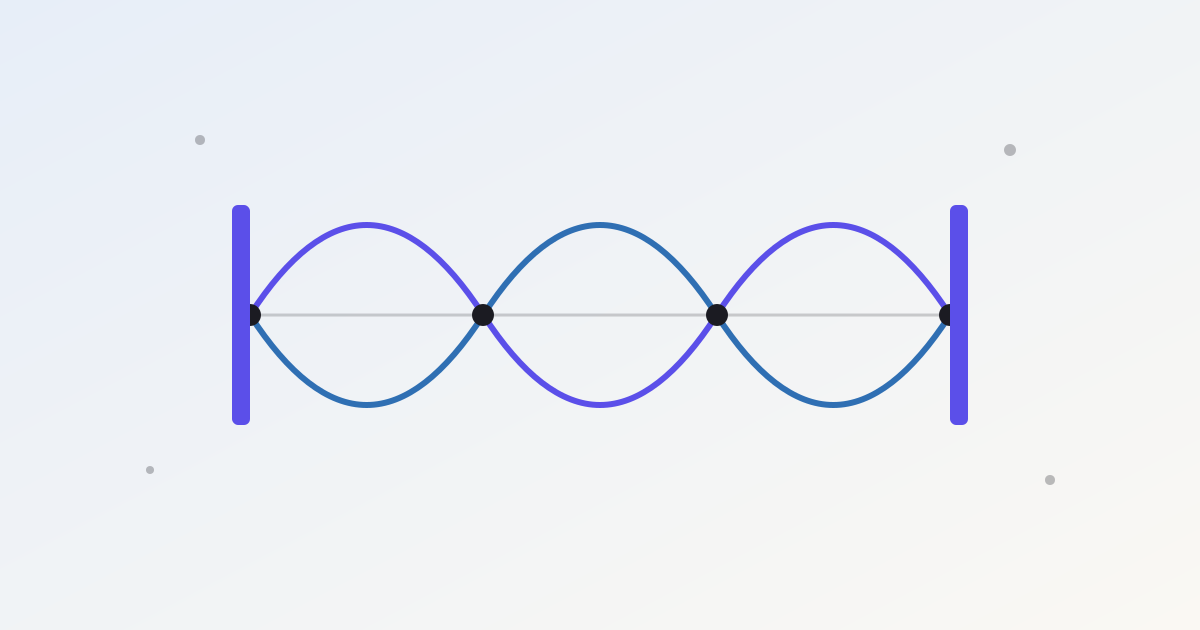
Trap a wave between two walls and resonance sharpens into something stricter still. A guitar string is pinned at both ends, so whatever wave runs along it has to stand still at those two points. Only certain wavelengths can manage that — the ones where a whole number of half-humps fits neatly between the ends. Those surviving patterns are standing waves, and their frequencies are the string's fundamental note and its overtones. Every other frequency you might pluck cancels itself out within a few reflections. The string is a filter that answers only to its own harmonics.
The same rule runs a surprising amount of the world. The air column in a flute picks its note this way; so does the resonant cavity of a laser, where only the wavelengths that fit exactly between the two mirrors survive to become the beam. It is even how you can measure the speed of light with a microwave oven: the oven traps a standing wave of microwaves, its motionless points and swinging antinodes fixed in space, cooking a row of hot spots half a wavelength apart. Nodes that hold still, loops that heave — the pattern is the same whether the wave is a plucked string, trapped light, or the microwaves warming your dinner.
The bridge that wasn't resonance
Resonance has a body count, and the story is usually told wrong. The clean case is real enough: on 12 April 1831 a column of soldiers marched in step across the Broughton Suspension Bridge near Manchester, their tread happening to match the bridge's own sway, and a section gave way beneath them. Ever since, armies order troops to break step when crossing a bridge — about the only piece of physics that made it into military drill.
But the famous one, the film every student is shown, is a different animal. In November 1940 the Tacoma Narrows Bridge in Washington State twisted itself apart in a mere forty-mile-an-hour wind, writhing like a ribbon until it tore. Generations of textbooks called it resonance — the wind, they said, arrived in gusts timed to the bridge's natural frequency. It didn't. The wind was steady, with no rhythm to match. What happened was flutter: the bridge's own twisting reached up and reshaped the airflow, which shoved the deck further in the direction it was already going, which twisted it more — a system feeding itself, not a system pushed from outside. The engineers Robert Scanlan and Yusuf Billah laid the confusion out plainly in 1991, and it is in the textbooks still.
The difference matters. In resonance, an outside push happens to keep perfect time. In flutter, nothing outside keeps time at all — the motion writes its own rhythm and the wind merely pays for it. Calling one the other hides where the energy actually comes from.
Tuning the invisible
Once you can see resonance you find it doing quiet work everywhere, and most of that work is useful. A radio is nothing but resonance: the tuner is a small electrical circuit whose natural frequency you slide up and down the dial until it matches one station's carrier, picked from the thousands of signals washing through the antenna at once. Only the matched one builds up; the rest are ignored. You are pushing one swing in a playground full of them.
Push deeper and the same idea becomes the machine you lie inside at a hospital. In an MRI scanner — the M is for magnetic resonance — the hydrogen nuclei in your body are made to wobble like tiny tops in a strong magnetic field, and a radio pulse tuned to exactly their wobble rate flips them all at once. Nothing else in the room answers; only the protons, only at their own frequency. The picture of your knee is resonance, read back out.
Even colour is a resonance. Light is absorbed by matter when its frequency matches a jump some electron is allowed to make — a resonance between the wave and the atom. When nothing matches, the light passes untouched, which is exactly why you can see through glass: visible light finds no rung to resonate with, so it is never stopped. When something does match, the light is drunk up and the leftover is the colour you see — and that same matching, between infrared light and the trembling of carbon-dioxide molecules, is what lets the greenhouse effect warm a planet.
A swing, a wine glass, a radio dial, the machine that photographs your knee, the warmth of the air itself: all of them are the one small law. Find a thing's own rhythm, keep time with it, and a whisper will move what a shove could not.