What the Greenhouse Effect Actually Does
Earth sits in the freezing dark of space, warmed by a star 150 million kilometres away. By rights it should be an ice ball. It isn't, and the reason is a thin haze of gas you have never seen.
The blanket that isn't a blanket
The usual image is that greenhouse gases "trap heat," like a blanket holding in warmth. Close, but the mechanism is the whole story, and the blanket picture hides it. Here is what actually happens.
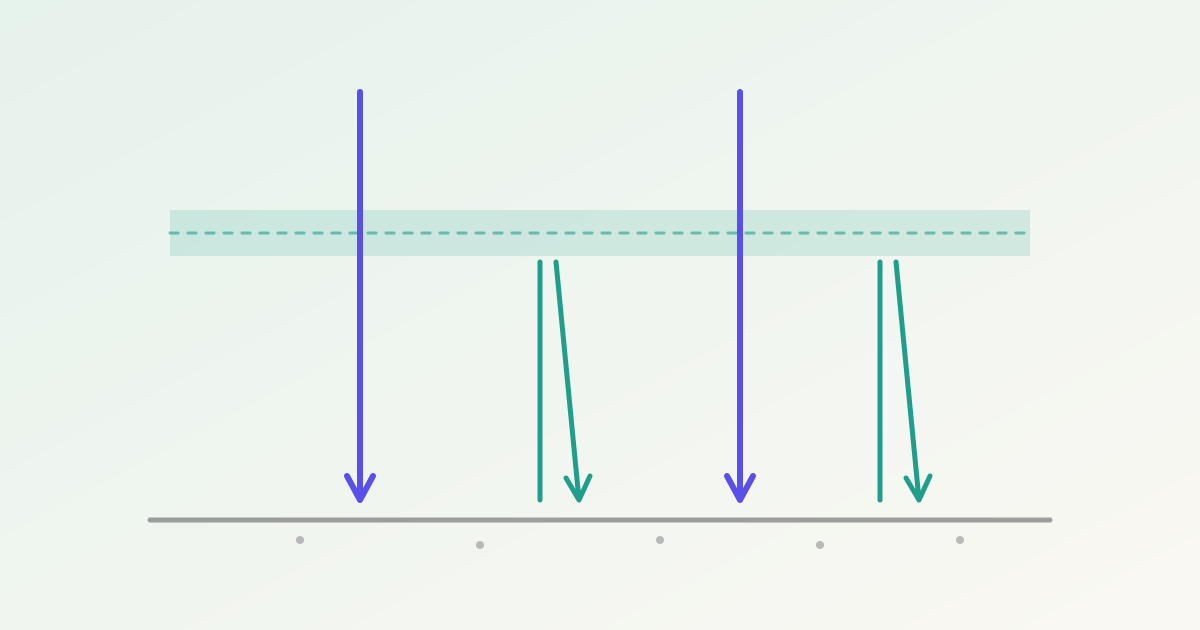
Sunlight arrives mostly as visible light — the colours the Sun pours out because of how hot its surface is. That light streams down through the atmosphere almost untouched and warms the ground. The warm ground then radiates its own heat back upward — but a merely warm surface doesn't glow in visible light. It glows in infrared, the long, invisible wavelengths that every warm object emits.
And here is the asymmetry that runs everything. The air is nearly transparent to incoming visible light but not to outgoing infrared. Certain gases — carbon dioxide, water vapour, methane — are built so that infrared light sets their molecules vibrating, and so they absorb it. Then they re-radiate it, in every direction, including straight back down. Energy gets in easily and struggles to leave. The surface settles at a higher temperature than it otherwise would — not because heat is "trapped," but because its exit is slowed.
The gases that do it, and the ones that don't
Not every gas plays. Nitrogen and oxygen — 99% of dry air — are nearly deaf to infrared, because their plain two-atom molecules can't flex in the right way. It is the trace gases, the ones measured in parts per million, that do almost all the work.
This was pinned down in 1859 by John Tyndall, who piped different gases through a tube and measured how much heat each blocked. He found the abundant gases were transparent and the rare ones — carbon dioxide, water vapour — were not. Decades earlier Joseph Fourier had asked the right question: why isn't Earth as cold as simple arithmetic says it should be? Tyndall found the mechanism. By 1896 Svante Arrhenius was calculating, by hand, how much the surface would warm if you doubled the carbon dioxide.
Strip every greenhouse gas out of the air and Earth's average temperature would drop to about –18 °C, a frozen world. The real average is about +15 °C. That 33-degree gift is the greenhouse effect — and without it you would not be here to resent it.
The proof next door
If you doubt that a trace gas can rule a whole planet's temperature, look at the two nearest worlds.
The Moon sits at Earth's exact distance from the Sun, with no atmosphere at all. Its daylight side roasts, and its night side plunges to around –170 °C, because nothing holds the warmth. Venus, meanwhile, is smothered in carbon dioxide, and its surface sits at about 465 °C — hotter than Mercury, which is far closer to the Sun. The same sunlight reaches all three; the outcomes differ wildly, decided almost entirely by what the air does to infrared light.
The greenhouse effect is not a pollutant or a modern invention. It is the ordinary physics that makes Earth livable in the first place. The only thing anyone argues about is what happens when you reach over and turn the dial.