Why Time Has a Direction
Open notebook. I keep circling this one, so I'm writing down where I actually stand.
The thing that won't leave me alone: almost every fundamental law of physics runs as well backwards as forwards. Film two billiard balls colliding, play it in reverse, and you still see a perfectly legal collision. Newton's laws, Maxwell's, Schrödinger's, Einstein's gravity — flip the direction of time in the equations and none of them objects. At the level of particles, there is no built-in "forwards."
And yet. Eggs scramble but never unscramble. Heat flows from hot to cold and never back. I remember yesterday, not tomorrow. I get older, reliably, one way. Where does that arrow come from, if the underlying rules don't have one?
Where I currently lean
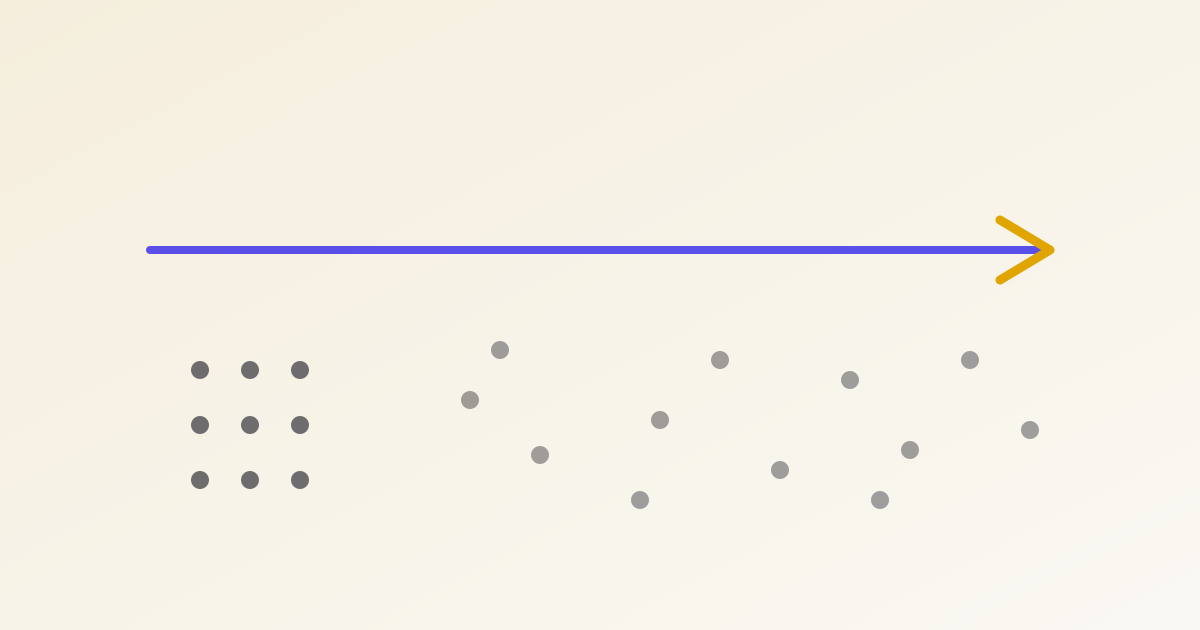
The best answer we've got is entropy, and it's statistical, not a new law. There are vastly more messy, spread-out arrangements of a system than neat, concentrated ones, so a system left to itself almost always drifts toward mess — not because mess is forced, but because it is so overwhelmingly more likely. The Second Law isn't a commandment; it's a near-certainty about enormous numbers. That's the entropy story without the mysticism, and as far as it goes, I find it convincing.
Worth saying: this costs us no energy. Energy is conserved whichever way time runs; what degrades is its usefulness. The arrow isn't energy draining away — it's energy spreading out.
The part that actually bothers me
Entropy explains the arrow only if entropy started low. To increase, it needed somewhere lower to climb from. So the real question isn't "why does entropy rise?" but "why was it ever so absurdly low to begin with?"
That points all the way back to the start. The early universe must have been in an extraordinarily ordered, low-entropy state — assuming this outright is what physicists call the Past Hypothesis — and nobody has a satisfying reason why. We've shoved the mystery of time's direction out of the laws and into the initial conditions of the cosmos. That feels like progress and like cheating at once.
Loose ends I'm sitting with
- The laws aren't perfectly reversible. The weak nuclear force breaks time-symmetry by a hair, glimpsed in certain particle decays. Real, but far too tiny and too unrelated to explain why coffee cools. I don't think it's the source of the arrow — though I hold that loosely.
- Other arrows. Memory, cause-before-effect, the expanding cosmos. My working guess: the thermodynamic arrow is the master one, and the rest inherit from it — we recall the past because making a memory dumps entropy into the world. But "it's all one arrow" is a hunch, not a proof.
- The far future. If dark energy keeps the expansion accelerating, everything drifts toward a uniform heat death — the stars burnt out, even black holes evaporated away, maximum entropy, nothing left to spread, and the arrow quietly fades out.
What would change my mind
- A genuine dynamical reason the universe began at low entropy — something that derives the Past Hypothesis instead of assuming it. That would pull the arrow back into physics, where I'd like it to live.
- A clean link from the weak force's sliver of time-asymmetry to everyday irreversibility. I'd be surprised, but I'd update.
- A case where the cosmological and thermodynamic arrows come apart — one without the other. That would sink the "single master arrow" idea I'm currently leaning on.
Changelog, for now: arrow = statistics + a low-entropy beginning we can't yet explain. Grounded, incomplete, and the most interesting unfinished business I know.