Emmy Noether and the Reason Energy Is Conserved
In 1915 the mathematicians at Göttingen had a problem with Einstein's new theory of gravity, and they sent for the one person they thought could fix it. She wasn't allowed to hold a job.
A puzzle in the new gravity
When Einstein published general relativity, it came with a nagging technical worry. In the older physics, the conservation of energy was rock-solid: energy could move around or change form, but the total never budged. In the strange curved spacetime of the new theory, the usual proof of that law seemed to fall apart. Energy conservation looked, for a moment, as though it might not hold — and a physical law that can quietly fail is a crisis.
David Hilbert and Felix Klein, two of the greatest mathematicians alive, wanted the matter settled, so they brought Emmy Noether to Göttingen. Among the people who understood her work, she was already recognised as one of the finest algebraists in the world. She was also a woman, and in the Germany of 1915 that was enough to bar her from a paid university post. Hilbert tried to push her appointment through and was blocked by the faculty. The retort attributed to him has followed the story ever since: he said he did not see why a candidate's sex should count against her admission — after all, the senate was a university, not a bathhouse. For years the workaround was that Noether lectured under Hilbert's name, and taught for free.
The theorem
What she proved, in 1918, was not a patch for one equation. It was a bridge between two ideas nobody had known were the same thing: symmetry and conservation.
A symmetry, in physics, means you can change something and the laws don't notice. Run an experiment today or run it next Tuesday: the laws of physics are the same either way — nature has no preferred moment. Do it here or a mile to the east: the laws don't care where you are — no preferred place. Turn your whole apparatus to face north instead of east: no preferred direction. Each of these is a symmetry: a change that makes no difference.
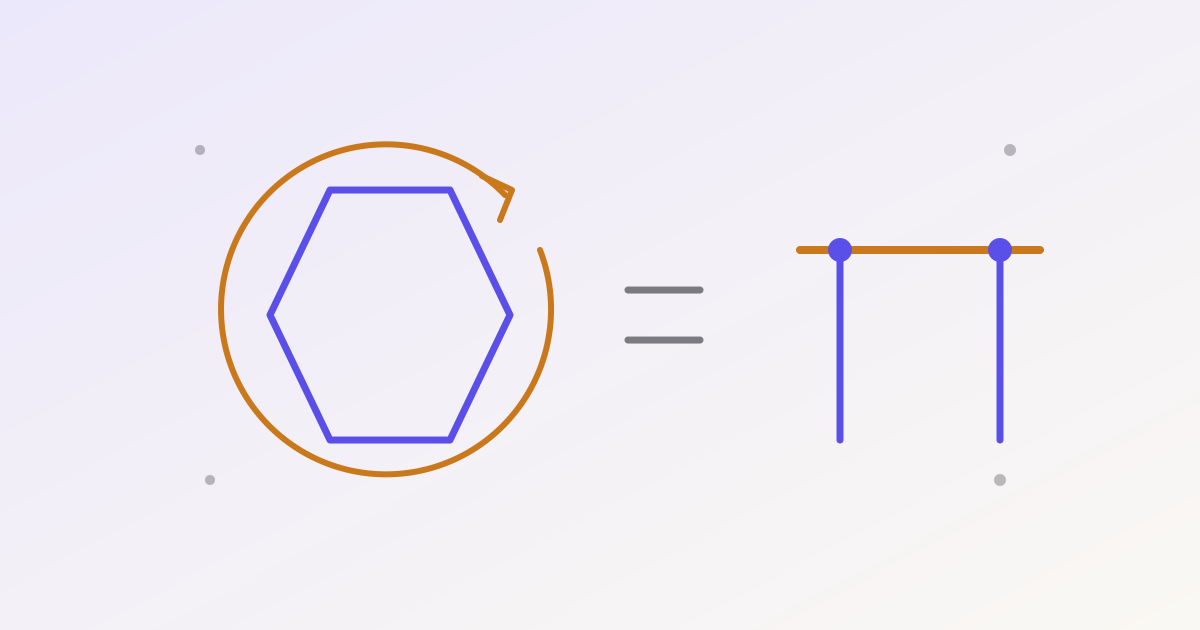
Noether's theorem says that every one of those symmetries has a conserved quantity hiding behind it, locked to it, one for one:
- Because the laws don't change over time, energy is conserved.
- Because the laws don't change from place to place, momentum is conserved.
- Because the laws don't care about direction, angular momentum is conserved.
Read that first line again, because it answers a question most people never think to ask. Why is energy conserved? Not because someone measured it holding steady in a lot of experiments and decided to trust the pattern. Energy is conserved because the laws of physics are the same from one moment to the next. The bedrock rule that energy is never created or destroyed turns out to be the shadow of a deeper fact: the universe doesn't have a favourite time.
A conservation law isn't a lucky accident of the world. It's what a symmetry looks like from the other side.
Why it cuts so deep
Once you see conservation and symmetry as two views of one thing, the puzzle that started it all resolves. In the ordinary, local universe, time looks the same going forward, so energy is conserved. But over the whole expanding cosmos, space itself is not the same from one age to the next — and exactly there, the tidy global law of energy conservation becomes genuinely slippery, in just the way general relativity had hinted. The theorem doesn't merely rescue the law; it tells you precisely when, and why, it can bend.
And it kept paying out, far past anything Noether had been asked to solve. Twentieth-century physics discovered that the deepest laws are built symmetry-first. The conservation of electric charge is the shadow of a subtler symmetry buried in the equations of electromagnetism. Every force in the modern catalogue of particles is tied to a symmetry of this kind, and the Higgs field earns its fame precisely by breaking one. Even Einstein's most famous equation sits inside this web: energy and mass are one currency because the symmetries of spacetime say they must be. Noether had handed physics the grammar it would speak in for the next hundred years.
The rest of the story
Noether finally won the right to lecture in her own name in 1919, and Göttingen became, for a while, a centre of her kind of abstract algebra — students came from across the world to work with her. Then in 1933 the Nazi government dismissed Jewish academics, and Noether, who was Jewish, lost even her modest position. She left for the United States and a post at Bryn Mawr College. She died there in 1935, at fifty-three, after surgery — at the height of her powers.
When she died, Einstein wrote to the New York Times that, in the judgement of the most competent mathematicians then living, Noether was the most significant creative mathematical genius produced since the higher education of women began. It was true, and it was also a smaller claim than she deserved — the qualifier was the world's fault, not hers.
She is not a household name. But her theorem is one of those rare results that changes what a question even means. Ask a physicist today why energy is conserved and you won't be told about careful measurements. You'll be told that the laws of nature keep no calendar — and that a woman who was, for years, forbidden to be paid for her work is the one who proved that this, and not luck, is why the books always balance.