How Planes Fly (Not the Way You Were Taught)
A 300-tonne airliner leaves the ground on nothing but moving air. The explanation you were taught for how isn't just simplified — it's wrong.
The story in every textbook
You've heard it. A wing is curved on top and flatter underneath. Two neighbouring parcels of air split at the leading edge; the one going over the hump has farther to travel, so it must speed up to rejoin its partner at the trailing edge at the same moment. Faster air means lower pressure — Bernoulli's principle — the higher pressure underneath wins, and the wing is pushed up.
Almost every step of that has a hole in it. There is no law of nature saying the two parcels must arrive at the back edge together, and when you actually film the flow, they don't: the air going over the top gets there earlier, not merely on time. The speed-up the story leans on is invented. Worse, this account predicts that a flat wing couldn't lift, and that a plane flying upside down would be pulled toward the ground — yet aerobatic pilots fly inverted all afternoon, and a flat sheet of balsa glides perfectly well.
What actually holds the plane up
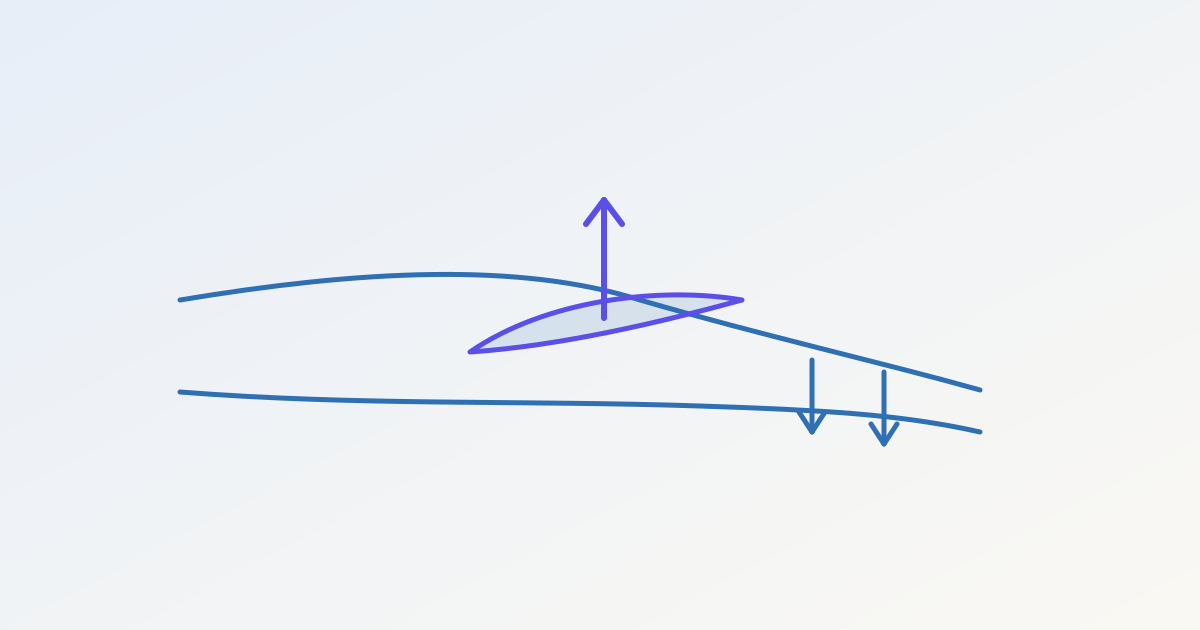
Stop tracking imaginary parcels and follow the air itself. A wing tilted slightly nose-up into the oncoming stream — its angle of attack — takes an enormous quantity of air and throws it downward. You can feel the principle by holding a flat hand out of a moving car window and tipping the front edge up: the air you deflect downward shoves your hand up.
That is the whole engine of flight. The wing pushes a river of air down; by Newton's third law, the air pushes the wing up by exactly as much. Lift is the reaction to flinging air toward the ground, ton after ton of it, second after second.
Bernoulli isn't wrong, by the way. The air really does move faster over the top, and the pressure there really is lower. But that's not a competing explanation — it's the same event written in a different ledger. The low pressure above and the downward-thrown air are two views of one flow, and Bernoulli's principle is itself nothing but energy bookkeeping for a moving fluid: trade some pressure for some speed, keep the total fixed. Both accounts, done carefully, hand you the identical lift.
Air is heavier than it feels
The stubborn part is believing that air — which you can't see and barely feel — could hold up a jet. But air has mass. A modest room holds tens of kilograms of it, a heft made vivid by the ceaseless molecular jostling that first proved atoms are real. Hurl enough of that mass downward fast enough, and it will carry a great deal upward in exchange.
A wing isn't sucked into the sky by a clever curve. It earns every gram of lift by shoving air down — which is exactly why a wing tilted too steeply, its smooth flow torn loose, abruptly stops flying and stalls.
Next time you're pressed back into your seat on takeoff, picture the real transaction happening under the wings: a vast weight of ordinary air, going down, so that you can go up.