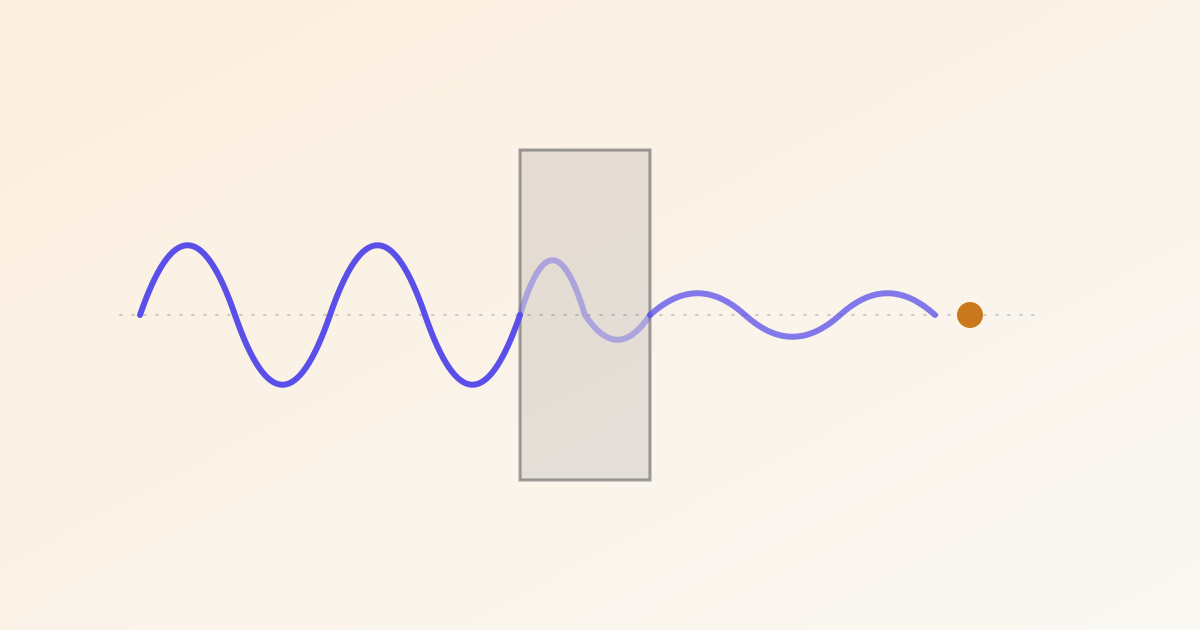
Tunneling: Walking Through Walls, Statistically
A particle walks up to a wall it cannot climb. Sometimes it is just... on the other side.
The impossible commute
Roll a ball at a hill. If you don't give it enough energy to reach the top, it rolls back. Always. Every time. That is the whole of everyday physics: not enough energy, no crossing.
Now shrink the ball to an electron and the hill to a thin barrier — a sliver of material it has no energy to get over. Send it in. Most of the time it bounces back, as expected. But every so often, with no fanfare and no energy to spare, it simply appears on the far side. It did not go over the wall. It went through it. We call this tunneling, and it is not a loophole — it is how the universe actually works at small scales.
Why a wall is more like fog
The trick is that a quantum particle is not a hard pellet with a sharp location. It is described by a spread-out wave of possibility — the same blurry, several-options-at-once character behind superposition. When that wave meets a barrier it cannot classically cross, it does not stop dead. It seeps into the wall, fading fast — and if the wall is thin enough, a faint trace of the wave leaks out the other side. Wherever the wave has any presence, the particle has some chance of being found there. A thin enough wall is never quite solid.
Two numbers run the whole show:
- Thickness. The chance of tunneling collapses exponentially as the barrier widens. A little thicker, and the odds plunge by factors of thousands.
- Mass. Heavier things tunnel far less. This is why you never sink through your chair — you are a vast crowd of heavy particles facing a thick barrier, and the odds are effectively zero for all of eternity. Electrons and protons, light and small, do it constantly.
Where it quietly runs your life
Tunneling sounds like a curiosity. It is, instead, load-bearing:
| Where | What tunnels |
|---|---|
| The core of the Sun | Protons, through their mutual repulsion, so fusion can start |
| A USB stick or SSD | Electrons, on and off a sealed memory cell, to store each bit |
| Radioactive decay | An alpha particle, escaping the nucleus that traps it |
| An atom-imaging microscope | Electrons, across a tiny gap, to map single atoms |
The Sun is the headline. Two protons must slam close enough to fuse, but they are both positive and repel ferociously — and at the core's roughly 15 million degrees they still lack the energy to make contact head-on. Classically, the Sun should not burn at all. It burns because protons tunnel through that wall of repulsion. Any single pair almost never makes it, but with the core fusing on the order of 10³⁸ nuclei every second, "almost never" adds up to a star that has shone for billions of years.
Tunneling is not teleportation, and it is not magic. It is relentless statistics: each attempt is a near-certain failure, repeated so many times that the rare success becomes a steady, reliable rate.
Your data persists, your microscope sees atoms, and the sky is bright — all because, given enough tries, the wall is never quite a wall.