Why a Passing Siren Drops in Pitch
An ambulance passes and its siren seems to slump in pitch, as if the driver leaned on a lever the moment it went by. The driver did nothing. The pitch dropped because you were standing still and the sound was not.
The pileup and the stretch
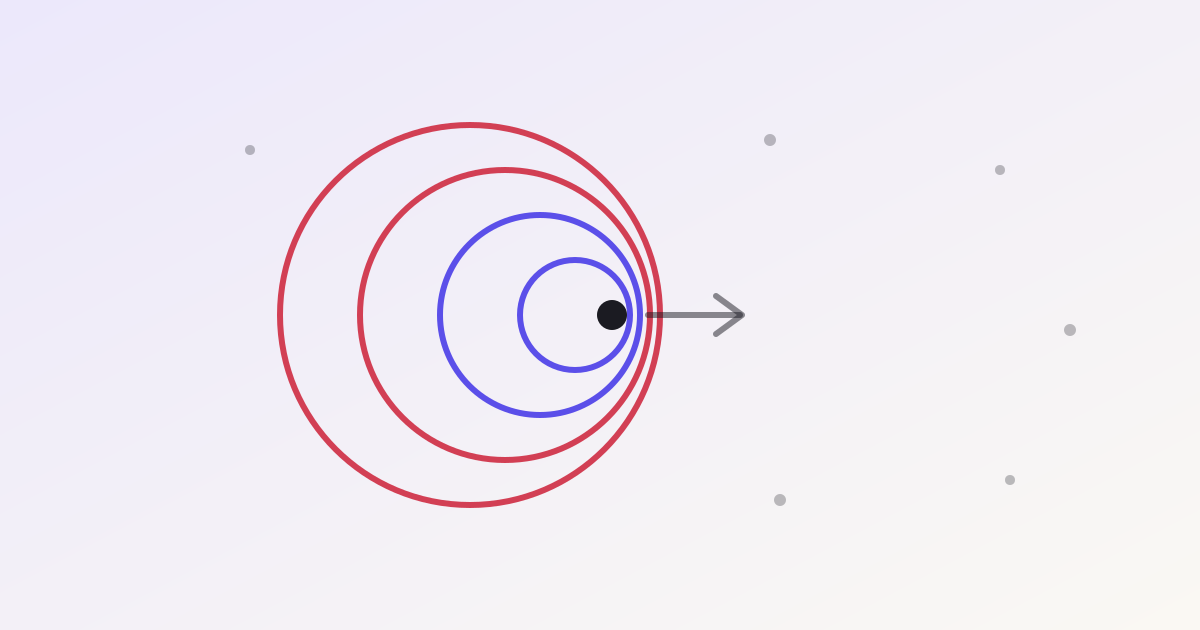
A siren holds a steady tone: a wave with a fixed number of crests leaving it each second. Picture those crests as ripples spreading out from the ambulance. As it drives toward you, every new crest departs from a spot a little closer than the last, so the ripples ahead of it crowd together — shorter wavelength, higher pitch. Behind it, each crest sets out from farther back, and the ripples stretch — longer wavelength, lower pitch. The instant the ambulance draws level and passes, you cross from the crowded side to the stretched side, and the tone falls.
Nothing about the siren changed. What the drop measures is not a property of the siren but of the geometry between you and it — which is why the driver, riding along with the crests, hears the original note the whole way. This is the Doppler effect, and that is the misconception it dissolves: pitch is not something a source has, it is something the space between you and the source does.
Trumpeters on a train
Christian Doppler, a struggling Austrian physicist, worked it out on paper in Prague in 1842, trying to explain the colors of double stars. He was wrong about the stars — the shift is far too small to tint them — but right about the effect. In 1845 the Dutch scientist Christophorus Buys Ballot staged a glorious test: he sat a band of trumpeters on an open railway car, had them hold one sustained note, and posted musicians with perfect pitch beside the track to write down what they heard as the train tore past. The pitch fell precisely as predicted. Three years later Hippolyte Fizeau noted the same shift must appear in light — not as a color you could see, but as a faint sliding of the dark fingerprint lines in a star's spectrum.
That sliding is now one of science's sharpest tools. A star that wobbles because an unseen planet tugs on it shows a rhythmic red-then-blue shift, and that is how many of the first exoplanets were caught. A police radar gun bounces microwaves off your car and reads the shift straight off. A hospital's Doppler ultrasound listens to blood, and to a fetal heartbeat, the very same way.
The shift that isn't quite a shift
Aim a telescope at a distant galaxy and its light is reddened too, which is why the effect gets folded into the story of the expanding universe. But that cosmic redshift is a different animal. The galaxy is not so much racing away through space as the space between us is stretching, lengthening the light in flight. For nearby motions the two are indistinguishable; across billions of light-years they part company — and even a source moving purely sideways is shifted, a leftover of time itself running slow that belongs to Einstein, not to Doppler.
A wave carries no clock and no ruler of its own. All it can tell you is how you and its source are moving apart — which is exactly why the falling siren is heard by no one aboard the ambulance.
Almost everything beyond reach — too far to touch, too faint to resolve — we know chiefly by how it is moving. And that we read, over and over, from the drop in pitch.