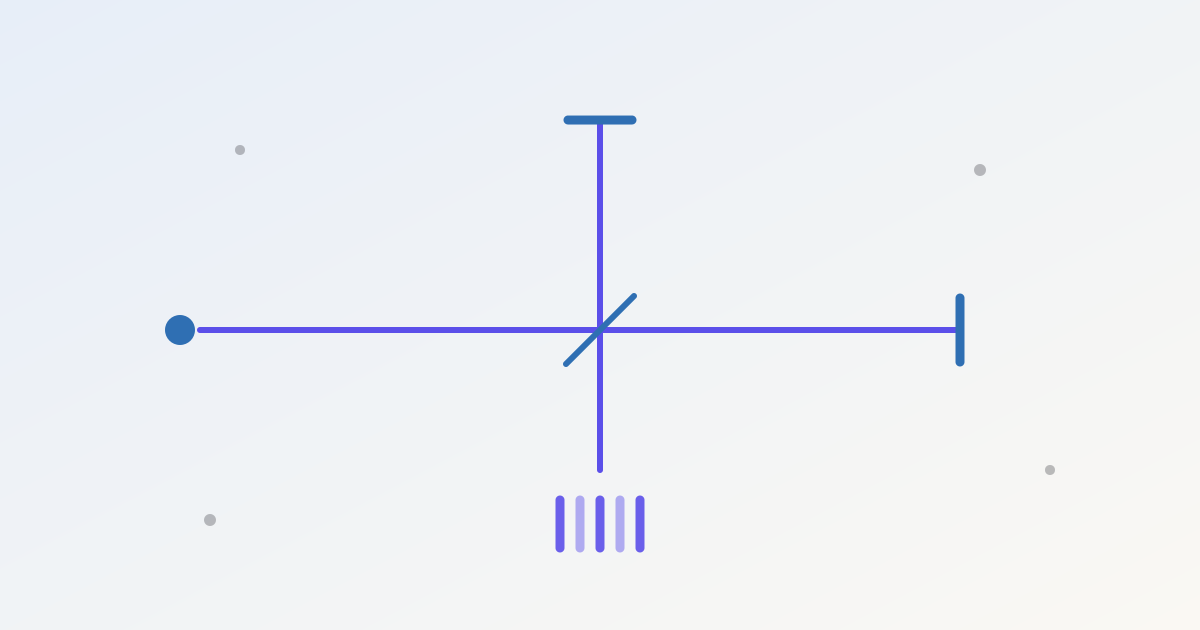
The Most Famous Failed Experiment
In the summer of 1887, two men in Cleveland built the most sensitive instrument on Earth to measure something that turned out not to exist.
The ocean nobody could find
By the 1860s, physicists were certain light was a wave. Thomas Young had watched it interfere with itself; James Clerk Maxwell had shown it was a ripple in the electric and magnetic fields, racing along at a fixed speed his equations pinned down exactly. But a wave, everyone knew, is a disturbance in something. Sound is a wave in air; ocean swell is a wave in water. Take the medium away and the wave has nothing left to wave. So light, being a wave, seemed to demand a medium of its own — an invisible, weightless, perfectly rigid jelly filling all of space, right through the vacuum between the stars. They called it the luminiferous aether.
The aether was not a crank idea. It was the sober, necessary consequence of everything then known about waves. But it came with a prediction. If space is filled with a stationary aether, then the Earth — hurtling around the Sun at some thirty kilometres a second — must be swimming through it. And a swimmer feels a current. Light sent along the direction of Earth's motion should take a slightly different time to make a round trip than light sent across it, exactly as a boat takes longer to row up a river and back than to cross the same distance and return.
There was only one difficulty. The difference was fantastically small. Earth's speed is about one ten-thousandth the speed of light, and the effect on the round-trip shrinks that ratio again by squaring it — down to one part in a hundred million. Maxwell himself, shortly before he died, wrote that no earthly experiment could ever be delicate enough to catch it.
An instrument to catch the wind
Maxwell had not met Albert Michelson. A Prussian-born officer of the U.S. Navy with a lifelong obsession for measuring light, Michelson had built a device of almost absurd sensitivity: the interferometer. Split a single beam of light in two, send the halves down two perpendicular arms to distant mirrors, and bring them back together. Where the returning waves line up crest-to-crest they reinforce; where crest meets trough they cancel. The result is a pattern of bright and dark bands — interference fringes. Because the fringes are set by the light waves themselves, they slide at the faintest change in how long either beam took to travel. A delay smaller than a single wavelength becomes something you can watch with your eye.
Michelson tried it first in Berlin in 1881 and saw nothing — but that instrument was marginal and the result inconclusive. So in 1887, now at the Case School in Cleveland, he joined the chemist Edward Morley to build the definitive machine. They mounted the optics on a massive slab of sandstone and floated the whole assembly in a trough of liquid mercury, so it could be turned in any direction without a shudder. They folded each beam back and forth between mirrors until its path stretched to eleven metres, multiplying the sensitivity. Then they set the great stone slowly rotating and watched the fringes, waiting for the aether wind to swing into and out of the arms as the apparatus came around.
The result that wasn't there
The fringes barely moved.
Turned every which way, measured at noon and at midnight, in spring and again in summer as the Earth's own orbit reversed its heading, the pattern stayed put. The shift they could see was a small fraction of the one the aether demanded — so small it was, within their error, indistinguishable from nothing at all. The Earth was ploughing through the aether at thirty kilometres a second, and the light did not so much as flinch.
It is the rare experiment remembered not for what it found but for what it refused to find. The most precise measurement of its age had returned, emphatically, a zero.
This was not a comfortable answer. A null result usually means the apparatus is broken — but Michelson's was the best in the world, and it kept saying the same thing. Either the Earth was somehow dragging the nearby aether along with it, an idea other observations ruled out, or the aether wind simply was not there. Physics had put a direct question to nature and been told, flatly, that the question was wrong.
Patching the hole
The first instinct was not to abandon the aether but to rescue it. In 1889 the Irish physicist George FitzGerald, and independently the Dutchman Hendrik Lorentz a few years later, proposed a startling fix: perhaps objects physically shrink along the direction they move through the aether, by precisely the amount needed to erase the delay. The stone slab, the mirrors, the arms themselves would contract just enough to hide the wind from the very instrument built to feel it.
On its face it was a fudge — a shortening conjured up for no reason except to explain away the one thing it explained. But Lorentz wove it into a full mathematical scheme, and the equations he wrote down to make it work were, curiously, exactly the right ones. He had the machinery of a new physics in his hands and was still spending it to prop up the old.
Throwing the ocean away
It took someone with no stake in the aether to see what those equations were really saying. In 1905 a young patent clerk named Albert Einstein began not from the failed experiment but from a plain refusal to make excuses. Suppose, he said, the speed of light is simply the same for everyone — every observer, however they move — and there is no aether to measure against at all. Then the contraction Lorentz had bolted on by hand falls out on its own, along with the slowing of moving clocks and the coming-apart of a universal "now." The aether was not undetectable. It was superfluous — the one wave in nature that needs no medium to carry it.
Einstein was always cagey about how much the Cleveland result had shaped him; he leaned more on the beauty of Maxwell's equations than on any single measurement, and historians argue the point to this day. But Michelson and Morley had done the thing that mattered: they had turned the aether's absence into a fact no one could talk their way around. Michelson himself never quite made peace with it. He took the 1907 Nobel Prize — the first American to win one in the sciences — for the sheer precision of his instruments, and went on measuring light for the rest of his life, half hoping the aether might yet turn up.
What the empty arms became
It never did. But the instrument outlived the idea it was built to test. An interferometer gauges distance by the wavelength of light, which makes it the most sensitive ruler ever devised — and once you hold the most sensitive ruler ever devised, you go hunting for the smallest things in the universe to measure with it.
In 2015, in two vacuum tunnels four kilometres long, laser beams split and recombined exactly as Michelson's had, and their fringes twitched by less than the width of a proton. The cause was two black holes a billion light-years away, ringing spacetime like a bell as they spiralled together and merged. LIGO, the machine that heard them, is a Michelson interferometer — the same crossed arms, the same split beam, the same patient watching of the fringes.
The apparatus built to find the ocean of the aether found instead that space is emptier than anyone had dared believe. Then it listened to that emptiness, and heard it ring.