The Vacuum Is Not Empty
Pump all the air out of a box. Pump out the light, cool it toward absolute zero, and shield it from every field you can. What's left inside is what physicists call the vacuum — and it is the most crowded, most restless nothing you will ever fail to see.
Why "empty" is the wrong word
In everyday language, empty space is the absence of stuff. In modern physics, space is not a stage that happens to be bare; it is made of fields — the electromagnetic field, the electron field, one field for every kind of particle in the roster of the Standard Model. A particle is just a ripple in its field. "Empty" space is what you have when all those fields are set as low as they can go.
The trouble is that a quantum field can never be set to exactly zero and left there. This is the uncertainty principle at work — the same rule that forbids a particle from having both a definite position and a definite motion at once. A field frozen at exactly zero would have both its value and its rate of change pinned down precisely, and quantum mechanics does not permit that pairing. So even in its lowest state, every field is forced to jitter. That irreducible tremor has a name — zero-point energy — and it means the vacuum is not the floor of an empty room. It's the surface of a sea that can never be made perfectly still.
The flickering crowd
Physicists often picture this jitter as virtual particles: pairs of particles and antiparticles flickering into being and annihilating again, borrowing energy for an interval short enough that the uncertainty principle lets the loan slide. It's a vivid image and a genuinely useful piece of bookkeeping — the calculations built on it are among the most precisely confirmed predictions in all of science.
But be careful with the picture. These are not tiny billiard balls you could photograph if only your camera were fast enough; they are a way of accounting for the fluctuations of fields that are always present. The honest statement is the plainer one: the vacuum has structure and energy because its fields can't hold still. The dancing particles are a story we tell about that fact.
A force out of nothing
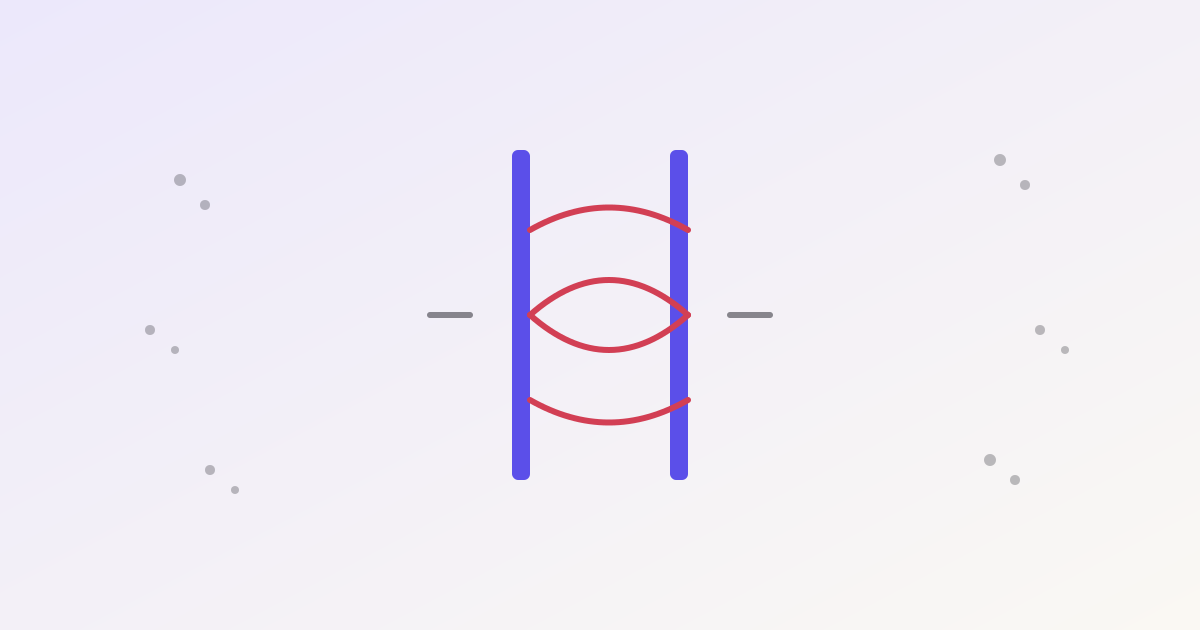
If this were untestable, it would be metaphysics. It isn't. In 1948 the Dutch physicist Hendrik Casimir predicted something startling: bring two flat, uncharged metal plates very close together in a vacuum, and they should feel a faint force pulling them together — a push from empty space itself.
The reasoning is pure wave-counting. Between the plates, the electromagnetic field can only fluctuate in patterns that "fit" — standing waves with a whole number of humps between the walls, exactly like the notes available on a plucked string.
Outside the plates there's no such restriction: every wavelength is welcome. So there are fewer allowed fluctuations in the narrow gap than in the open space around it — which means slightly less vacuum energy between the plates than outside them. Nature rolls toward lower energy, and the plates are pushed together. The effect is tiny, and it was finally measured cleanly in 1997, matching Casimir's prediction. A force with no charges, no fuel, and no fields you put there — arising from the mere fact that empty space has less room for waves in a narrow gap.
The same restlessness turns up elsewhere. At the edge of a black hole, vacuum fluctuations are thought to be the source of the faint glow that lets black holes slowly evaporate. And the vacuum's energy needn't average to zero even once all the jitter is tallied: the Higgs field settles at a value that isn't zero, which is part of why particles have mass at all.
The worst prediction in physics
Here is the honest, unresolved edge — and it's a big one. All that zero-point energy should carry weight. In Einstein's gravity, energy bends space, so the vacuum's own energy ought to push on the expansion of the universe. We even have a candidate for what that push looks like: the mysterious dark energy driving the cosmos apart.
The problem is the number. When physicists try to add up the vacuum's energy from first principles, the answer comes out larger than the dark energy we actually measure by a factor with something like 120 zeros after it. Not off by a little — off by more than any other prediction in the history of science. Something enormous must be cancelling nearly all of it, leaving just the faint residue that drives the expansion. Nobody knows what.
The emptiest thing we can make is the one we understand worst. We can feel the vacuum's push between two plates to within a few percent — and we can't explain its weight to within a hundred decimal places.
So the vacuum is not the blank backdrop the word suggests. It's a physical thing, with energy, with structure, with consequences you can push on in a laboratory — and with one number so far out of joint that it may be pointing straight at a piece of physics we haven't found yet. When someone tells you space is empty, the truer sentence is that space is as empty as it is allowed to be, which is not empty at all.