Where a Soap Bubble Gets Its Colors
Soap is colourless. Water is colourless. Blow a bubble from the two and it swirls with every colour there is — greens sliding into magentas, gold bleeding into blue — all of it moving, none of it painted on. Where do the colours come from, if nothing about the bubble is coloured?
Not pigment, not a prism
A rainbow gets its colours by bending sunlight and fanning it out, each colour bent by a slightly different amount. A soap bubble does something else entirely. Its colours don't come from bending light, and they certainly don't come from dye. They come from the film being almost unimaginably thin — thinner than a single wavelength of light — and from a quirk of what happens when a wave reflects off two surfaces at once.
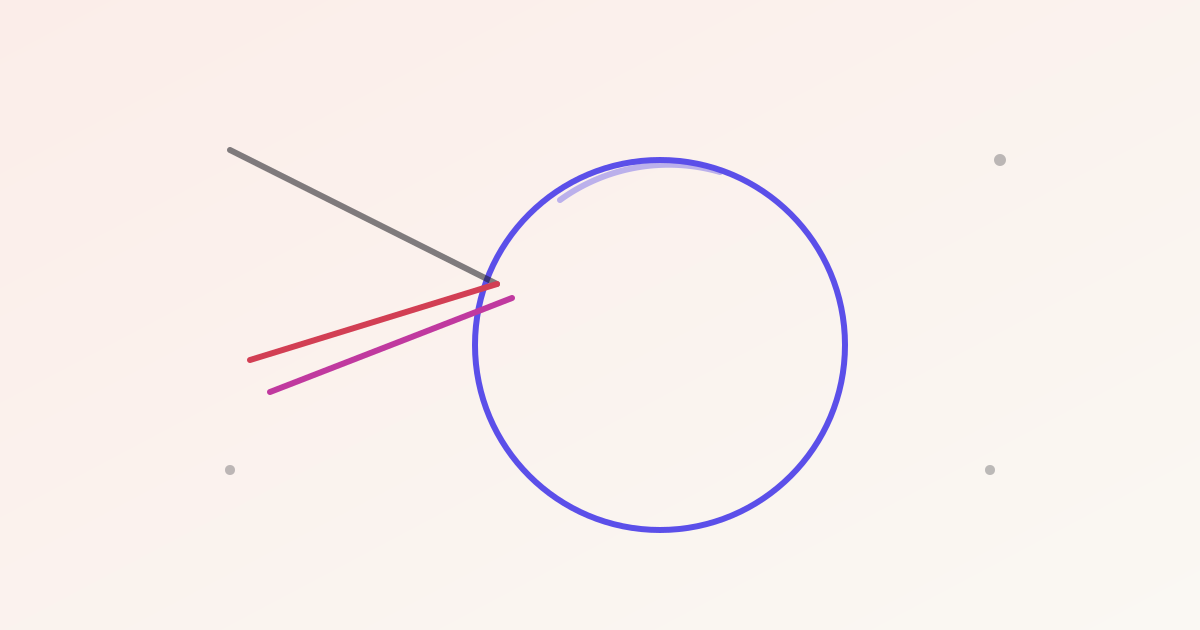
Light hitting the bubble doesn't reflect from a single surface. A little of it bounces off the outer face of the soap film; a little more carries on, crosses the film, and bounces off the inner face. Two reflections come back to your eye from the same spot — and the second one has travelled a hair farther, the extra round-trip through the thickness of the film.
Two reflections that agree, or don't
Light is a wave, with crests and troughs. When the two reflected waves rejoin, whether they add up or cancel out depends on that tiny extra distance. If the second wave comes back with its crests lined up on the first's, they reinforce, and that colour blazes. If it comes back half a step off — crest against trough — the two erase each other, and that colour vanishes. It's the same adding-and-cancelling of waves that paints the fringes in the double-slit experiment; here the two "slits" are simply the two faces of the film.
The catch is that "half a step off" depends on the colour, because each colour has its own wavelength. At a given film thickness, red might reinforce while blue cancels; a little thicker, and the winner changes. A bubble's wall is never uniform — gravity drains it, so it's thinner at the top and thicker below — and it's always shifting. Every thickness picks a different colour to show, and the colours slide around as the wall flows.
The colours aren't in the soap. They're in the arithmetic of two reflections that don't quite agree on where the crest should be.
The black warning
There's a lovely tell that this is the real mechanism. Watch a bubble in the last moment before it bursts. At the very top, where the film has drained to almost nothing, a patch turns not white, not silver, but black. That's because one of the two reflections gets flipped when it bounces, so when the film becomes far thinner than any wavelength, the two waves come back exactly out of step for every colour at once. Nothing reflects at all. The black spot is the film announcing it has thinned to the breaking point.
The same trick is everywhere once you know it: the sheen on a puddle with a drop of oil in it, the colours in a beetle's shell or a peacock's tail, the flash off the back of a CD. None of it is pigment. It's structure — light interfering with itself — and it's a close cousin of the reason the daytime sky is blue: colour built not from paint, but from the way light and matter happen to be arranged.