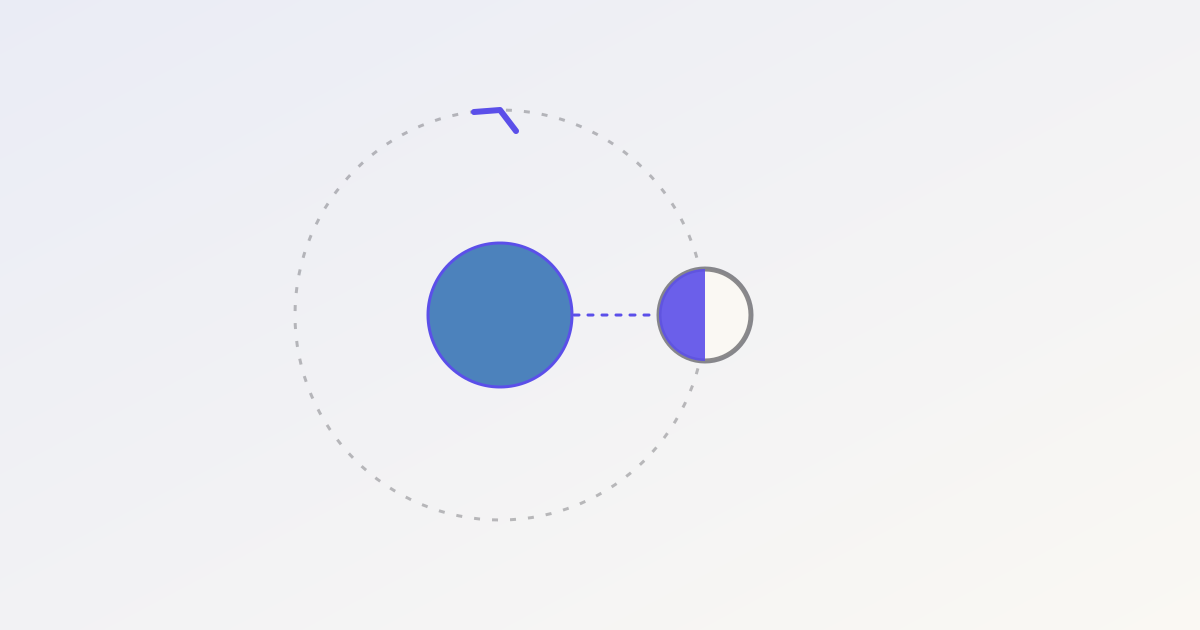
Why the Moon Always Shows Us the Same Face
The Moon keeps the same face turned toward us, night after night, century after century. The obvious conclusion — that it must not be spinning — is exactly backwards.
The tempting wrong answer
Since we only ever see one hemisphere of the Moon, it seems clear enough that the Moon simply doesn't rotate: a fixed ball hung in the sky, one side forever toward Earth.
Test it with your own body. Walk a full circle around a friend while always facing them. By the time you're back where you started, you've turned yourself all the way around, once. To keep one face pointed at something you're circling, you have to rotate — exactly once per lap. A Moon that genuinely didn't spin would, over one orbit, turn every side toward us in succession. The fact that it shows a single face means it is rotating precisely once per orbit — about every 27.3 days, matched to its trip around us to staggering accuracy. It spins. It just spins in perfect step. That lockstep has a name, tidal locking, and it is no accident.
The tides did it
Earth raises tides in the Moon exactly as the Moon raises them in our oceans — the same stretching-by-difference, the true fingerprint of gravity. The newborn Moon spun faster than it orbited. Earth's pull drew it into a slight egg shape, a bulge of rock aimed roughly our way. Whenever the spin ran ahead of the orbit, that bulge was carried off-center, and Earth's gravity hauled back on it — a patient brake. Turn by turn the braking bled the rotation away until the Moon turned just once per orbit and the bulge came to rest, pointed at us. With nothing left to drag off-center, there was nothing left to slow. The Moon had locked.
We miss the far side not because it's dark, but because the Moon turns in lockstep with its orbit. The "dark side of the Moon" gets just as much sunlight as the near side — two weeks of day, two weeks of night, the same as here. It is the unseen side, never the dark one.
What we actually get to see
A little more than half, in fact. The Moon's orbit is faintly oval and faintly tilted, so it seems to nod and roll as it travels, letting us peek around its edges. Tally up this wobble — libration, astronomers call it — and over a month we glimpse about 59% of the surface. The remainder stayed hidden from every human eye until a Soviet probe photographed it in 1959.
And the process is still running; it has only turned on us. The same tidal friction is slowing Earth's spin and coaxing the Moon outward by a few centimetres a year — about the pace your fingernails grow. Our days lengthen by a couple of milliseconds each century. Given long enough — far longer than the Sun has left — Earth would lock too, one hemisphere left staring at a Moon that no longer rises or sets.
The Moon isn't holding still. It keeps time with us so exactly that it only looks that way.